Category: Cover Letter

You Passed The 10 Second Screen. You May Still NOT Get A Call. WHY?

After the storm of controversy I created with the article, “How Recruiters Read Resumes In 10 Seconds or Less” (Click here if you haven’t read it), I thought it would be appropriate to follow up with what candidates, that pass the 10 second screen, can do to get a call from a recruiter.

Whether you like recruiters or  hate them, they are a necessary part of the equation in a job search. Some will fight the system, while others will embrace it. My only goal is to help educate candidates that want to understand how recruiters work. I do this to help candidates, not hinder them. I believe the more information you have about how we work the better it is for you.  Together we can then help each other.

Recently I calculated approximately how many resumes I have reviewed in 30 years as an executive recruiter. It is close to, and probably exceeds, 1 million. That is a whole lot of resumes. That number scared me. After 30 years of doing anything, one should get a feel for what works and what doesn’t.

So before you send me a nasty comment, I’m going to take the position that I’m as good at what I do after 30 years, as you are at what you do after 20 years.

By doing the following and including these few things on your resume, I believe you can dramatically increase your response rate.

1) NEVER use a functional resume. PERIOD. Before you come up with reasons to justify it, the key word in the sentence is NEVER.  I have never, ever met a recruiter that reads them. In addition, I very rarely have talked to a hiring manager, CEO or HR person that reads them. Why fight this battle? Even if 10% read them, that means 90% don’t. Which side of that equation do you want to be on? Considering that 100% read chronological resumes, you don’t want to fight this one. Join the 100% club and use a chronological resume.

2) The format is not as important as the content in the resume. My experience with speaking with candidates is that they spend a lot of time on the format; what should go on top, where should I put the education, do I need an objective, how long should the summary be, etc.  Spend more time making sure the content communicates to the reader what they think is important. I have yet to meet anyone, who told me, “I sure like all of their experience. They are really qualified, but they put their education in the wrong spot on their resume, so they are out.” The article, “Resumes Are About Substance Over Form” gives a lot of good information on this topic. CLICK HERE to read it.

3) Help us help you. All recruiters need to know certain things to make a decision to call you. The very basics include:

a) Some information on the companies you have worked for such as, size, number of locations, industry and products. This can be done in one sentence or less. Just the name of an unknown company is worthless when screening. You want to stand out from the rest.

b) If you are in management, a little about your organization such as, number of people you manage, are any of them managers, titles, and are they all in the same location.

c) If you are in sales, who are your customers? If not by name, at least what industries you call on, are you selling B2B or B2C, product description, territory size, and average size of the sale. I am constantly amazed that most sales people exclude this information. As a salesperson what you are selling is pretty darn important for the reader to know.

d) For technical people, what technologies are you working with? What language are you programming? If in engineering, is it a highly custom engineered part, are you working on a system or a component, are you designing nuts and bolts or toys? Seems important to me.

d) Include quantifiable results in the accomplishments. If you don’t, these are meaningless and most other resumes will read the same as yours.

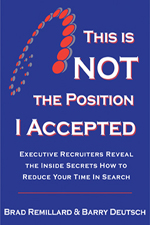
The first comment I get from candidates when I suggest these things is, “My resume will be too long.” No, it won’t. I have prepared thousands of resumes and I can get all of this on two pages. In fact, in our book, “This Is NOT The Position I Accepted” (CLICK HERE to review)  there is an example of a two page resume that contains all of this information. The person has over 20 years experience, so it is very doable.

Getting in the “A” pile is your responsibility, not the reader’s.

I wish more candidates would help us help them. All you have to do is give us the information we need to call you.

Contrary to what you may think, recruiters want to fill the position just as badly as you want the position.

For a FREE example of a cover letter CLICK HERE.

For a FREE example of a Thank You letter CLICK HERE.

For many more FREE resources and articles, join our Job Search Networking Group on LinkedIn. 4,300 people have done this. CLICK HERE to join.

I welcome your comments and thoughts.

Brad


2 Types Of Resume Key Word Searches You Must Get Past

There are two types of resume key word searches. It is my opinion after having spoken with hundreds or maybe thousands of candidates that the vast majority focus on the wrong type. The result  is they rarely get a call back.

The two types of resume key word searches are (starting with in my opinion the least important):

1) The automated key word search. The most commonly thought of when most people think of key word searches. It is used by resume management systems. This is the type used by most job boards like Monster and Careerbuilder.

Although these play an important role, for the most part they play a much smaller role than most think. Granted for those screening resumes using the resume databases on one of the job boards, the key word search is important. But how many hiring managers, HR execs, CEOs actually spend a lot of time doing this? I have asked hundreds of these and very few claim they even use the resume databases. They are just too expensive. Most just run an ad and wait for the responses. Third party recruiters  and those companies that can afford on-site recruiters will spend time searching the databases, however, this is a small percentage.

The majority of  hiring is not done by large or Fortune 500 companies. Iit is done by the mid and small size companies.  The fact is most mid and small size companies can’t afford a sophisticated resume management system. This  then eliminates the importance of the automated key word search in the vast majority of hiring.

It is for this reason, coupled with the fact that most hiring managers don’t spend hours sorting resumes on the job boards, that I believe this is the least important of the two.

The hands down most important resume key word search is done 100% of the time by every CEO, HR person, hiring manager or recruiter. This is why it is so important. Yet, most candidates show complete surprise when in our coaching session I mention it.

2) The human eye key word search. This  is done with the eyes of the person scanning your resume. That person is looking for key words or phrases to jump off the page. They want their eyes to latch on to these as they move down the page. Most have trained their eyes to be on the lookout for these key words.

This is the key word search candidates should focus on. Yet so many candidates have a generic, one-size-fits-all resume that the key words are either missing,  buried so deep in a paragraph or are mentioned only once on page two of the resume, the key words or phrases are never noticed.

Here are a few suggestions to get past the human eye key word search.

Do you:

1) have the key words or phrases embedded multiple times in the body of the resume. Not just at the top of your resume.

2) have quantifiable results associated with your accomplishments. Don’t write out numbers. Actual numbers stand out more to the eye.

3) have the key words or phrases listed under multiple positions or companies.

4) have these words or phrases at the beginning of  the sentence or bullet point so the eye catches them. We read left to right. Don’t bury them in a long paragraph where it is hard for the eye to catch.

5) have them aligned with the advertisement or job description.

6) have them listed in your cover letter. You can download a sample cover letter for free that will show you how to do this. CLICK HERE to download.

7) have them re-enforced in your thank you letter. You can download for free a sample thank you letter that will show you how to do this. CLICK HERE to get yours.

These are just a few things you can do to get past the most important key word search – the person reading your resume.

In summary, if you do all the things necessary to get past the human key word search, I firmly believe you will by default have the proper  key words to get past the automated search.

For more information on building a resume that will get noticed and get you the call back, take a look at our job search workbook. It provides solutions to the most common mistakes candidates make during a job search.   Like this one. We will send it to you for just the cost of shipping ($5 USA only). CLICK HERE to learn more.

Join our Linkedin Job Search Networking group. Over 4200 people have. There is a wealth of articles and other resources for you in this group. CLICK HERE to join.

I welcome your thoughts and comments.

Brad Remillard


How to Give Your Resume a Booster Shot

Give your resume a booster shot and improve your ability to get interviews now!

Your resume needs a booster shot.

No longer is a simple 2 page resume enough to capture interest.

It’s boring.

It’s mundane.

It’s ineffective at fully telling your story (especially if you missed the last dozen or so blog posts that Brad and I wrote about putting together a good resume and cover letter – cycle back and read some of the posts first).

Along comes the explosion of social media/social networking and like magic – instant resume booster shot.

So, if social media/social networking is so darn powerful, why are so few executive and managerial job seekers NOT using it effectively?

Let’s zero in on one specific tool – LinkedIn.

LinkedIn could be a panacea for job seekers. First, almost all recruiters, HR people, and hiring managers are doing two things when they see a resume that is a potential match for their open position – they Google your name and they search for you on LinkedIn.

Personally, I go to LinkedIn first.

  • As a Retained Executive Recruiter, I want more information about you.
  • I can’t get enough.
  • I’m insatiable when it comes to learning about who you are even before I pick up the phone and talk to you.
  • I’m trying to leverage my time, and this discovery process is far quicker than wasting time on the telephone.
  • I want the kind of depth of who you are that I cannot glean from your resume and cover letter.

This approach to researching job seekers is becoming more common.

Don’t be the one who misses the train.

You’ve now read about it in almost every business publication, heard from the experts, read about it on blogs such as this one, and your mother last week pointed out the growing importance of building your profile on-line when she saw the segment on the CBS evening news.

Unless your resume literally “blows me away”, I need more information to decide if I want to talk with you about one of my open executive searches. By the way, I might come across one resume every quarter that “blows me away”. Most just fade into the woodwork with their “bland” approach. I want your information to leap off my computer screen, smack me in the forehead, and scream at me that I would be an idiot not to want to learn more about you by immediately pick up the phone to talk with you.

Don’t fall victim to being “vanilla”

Don’t fade into the woodwork.

Some might call me lazy – I prefer to think of myself as highly effective at leveraging myself in time management. This process of quickly discovering whether you’re worthy of a phone call from me as recruiter – by matching your resume with your LinkedIn Profile has probably boosted my productivity by a factor of 2X-3X. I’m now able to spend time on the phone and in-person with the right candidate.

In the next few blog posts, we’ll re-visit how to specifically leverage LinkedIn as a Job Seeker to give your resume a booster shot in the arm. If you’re not effectively using LinkedIn as a resume enhancement tool, shame on you. If you’re not even on LinkedIn and you’re a manager or executive – sorry – but the train has left the station without you!

Here’s a suggestion I would like to toss our to our readers: In preparation for the next blog article in this series titled – “Job Search Marketing 101 – Your LinkedIn Profile Heading”, I would encourage you to complete our one page scorecard for assessing the effectiveness of your LinkedIn Profile for Job Search.

Download our FREE LinkedIn Profile Self-Assessment

Thousands have used this FREE tool to dramatically give their paper resume an on-line booster shot in the arm. Now armed with your self-assessment of your LinkedIn Profile, you’ll be well prepared as we dive deeply into the various components of leveraging LinkedIn to create a powerful online personal brand for yourself, a powerful magnet to attract recruiters and hiring managers, and a beautiful enhancement to your resume that was not possible just a few years ago.

Barry Deutsch

Join the conversation in our LinkedIn Discussion Group as other managers and executives discuss how they’ve leveraged LinkedIn to give their resume a booster shot.

Does Your Resume STINK? Is that the problem?

Holding your nose because your resume stinks

Did you know that the number one reason most candidates don’t get called for an interview after submitting a resume is that their resume and cover letter STINKS?

Reminder – LAST CHANCE to take Advantage of our Special One-Time Resume and Cover Letter Webinar tomorrow — Friday – January 29th – Special Appreciation Rate and Bonus Materials


If you’re not getting a high number of “bites” on your resume when you forward it to networking contacts and submit it to employers for their job postings, perhaps the problem is not so much with the economy – but rather in the document you’ve created to market yourself.

Can you afford to have a resume and cover letter that STINKS?

No wonder the average time for a manager or executive to find a job is creeping beyond 6 months into the 12-18 month plus time period.

How many months will you continue to deplete your savings account and base your job search on hope and luck by using a resume and cover that STINKS?

We’ve put together a very special webinar for the members of our job search community. One hour is all it takes to learn how to create a powerful marketing document that grabs employer’s attention and makes them want to pick up the phone and call you.

The best news is that we’ve cut the price in half for our loyal readers and followers and we’ve thrown in a few HOT items that will help your job search. You’ll NOT find a less expensive webinar packed with as many ideas – tactics – and helpful advice anywhere on the Internet.

Learn the inside secrets of creating and leveraging a power marketing document to get interviews and finish your job search quickly.

Join us for this webinar (probably will only be offered ONCE this year) which is special appreciation webinar for our job search community of loyal readers and followers.

Click the link below to take advantage of this unique private offer to our job search community reducing the normal fee for the webinar from $89.95 to $39.95 and the inclusion of two of our HOT audio programs – a total value of over $150.00.
Last chance to sign up TODAY. Click this link to register now:


SIGN UP-GET MORE INTERVIEWS WITH YOUR RESUME

Join me on Friday January 29th at 9 AM to start conducting an effective job search NOW!

Barry Deutsch

Photo courtesy of megngarnett