Posts tagged: Thank You Letters

How To Get Recruiters To Reply To Your Resume

I know this is one of the major complaints by candidates. I hear it all the time, “I send them my resume and they don’t reply. Most won’t even return my phone call.”  As difficult as it is to say, for the most part these candidates are correct. That doesn’t mean it is right, it just means you are correct.

Similar to most at the manager level and above, when you are working, you are generally overwhelmed with things to do. So you have to prioritize. Some things are high priority and some things go on the low priority list. The low priority items may never get done, or may get done in the next few months. Generally, this depends on what other higher priority items trickle in.

Recruiters are really no different. We have to prioritize our day. Some things are high priority and other things are low priority. If  you want to engage recruiters, your job when working with or contacting them should be to move up the priority list. Knowing how I, and many other recruiters prioritize, might help you do this.

Here is how I set priorities regarding the basic duties as a retained recruiter.  Contingent recruiters might vary slightly, but when I was a contingent recruiter it wasn’t a whole lot different.

High priority:

  1. Clients always come first. So some might ask, “Who is your client?” The company paying my fee is the client, not the candidate. Therefore, the company has first priority on my time. That means I will return their phone calls before a candidate’s, I will meet with them prior to a candidate, reply to their emails first,  and screen resumes they send me first.
  2. Candidates on an active search. These are candidates that I’m actively working with on an existing retained search. They could be at any stage within that search which includes, recruiting ones I have identified, interviewing them, returning their calls or emails, reviewing their resume, meeting them, scheduling interviews, following up after an interview, compensation discussions, reference checking, or basically anything I need to do to move the candidate and the search to the next phase.
  3. Marketing. The next priority for me is marketing. This is meeting with clients and potential clients, attending networking meetings, and making sure I’m out in the market so that when a search comes up I’m the one that gets the call. When that call comes, refer to number 1 above.

Important but not a high priority. These I try to get to by the end of each day. Sometimes they spill over to the next day, but I usually try to complete these within 24 hours.

  1. Returning emails not related to a search from people I know or have worked with in the past. These are generally people updating me on their search, prior clients with a question, a request unrelated to an active search, general emails, and clearing SPAM. Sometimes I don’t get to these until the afternoon. I scan down the “sent from” and subject lines, and when I see someone I know I will read the email and then reply appropriately.
  2. Reply to emails and return calls that are a referral. If someone is referring a person to me, I will always reply. I respect the fact that they have taken the time to do this. I feel I owe the reply out of respect to the referring source.
  3. Return voice mail calls. Basically the same as above. I listen to them and clients get an immediate call. Anything to do with an active search gets a call. Others I evaluate and make a decision on what to do with them. Refer to low priority below for many, not all, of these calls.

Low Priority:

  1. Return emails from those I don’t know. This is one of those low priorities that tick many candidates off. The good news is that you have a much higher chance of getting a return email than a phone call. I often try to catch up on these on the weekend or at night. Because of the large volume of these, I’m often two weeks behind.
    1. If you are just sending me an unsolicited resume, I may or may not reply to you. Generally not. I may take a look at the resume to see if it fits an active search. Probably less than 50% of the time I reply. This is why I preach, tweet, and blog,  DON’T WASTE YOUR MONEY ON A RESUME SERVICE THAT WILL SEND YOUR RESUME TO 1,200 RECRUITERS. Save your money as most recruiters don’t even look at them. I doubt more than 5% of retained recruiters do.
    2. If the email is just to introduce yourself to me with no referral,  I will probably just delete it. What else can I say? Like me or hate me, that is what will happen. (If it makes you feel better, then “yes” I spend hours late at night reading the hundreds of unsolicited resumes I receive on a weekly basis).

Lowest priority. So low that I have to be bored and/or very lonely to take action. I’m desperate to just talk to someone and my wife and kids are all busy. I have probably already called every person in my contact list, any tech support that I can possibly think of, and if it’s the only way to get out of having to watch Driving Miss Daisy or The English Patient, I will claim I have to return these phone calls.

  1. These are the  voice mails that simply say, “Hi Brad, this is (fill in the blank) please call me at (fill in the number. I probably don’t even recognize the area code).” or “Hi Brad, this is (fill in the blank) I just want to introduce myself to you. Please call me at (fill in the blank).”  I will apologize now to all of those I have offended. Sorry, if I didn’t return your call.  It is just that I don’t have the time, and I rarely can help you.  I know each call is going to take 5–10 minutes, and in the end, I can’t do anything for you. I used to make a list of these calls. When time permitted, I would work my way down the list but over time the list just got too big. For every 3 calls I returned, I added 5 or 6. I stopped adding to the list when it exceeded 100 calls to return. Sorry, but this many calls to return just isn’t possible. Heck, it is hard enough to reply to that many emails.

It isn’t personal, and please don’t take it personally, when recruiters don’t get back to you. Most recruiters are not trying to be rude, but as I said in the first paragraph, we only have so many hours, just like everyone else, and we have to manage our time too.

My guess is that most managers, when working, don’t have time to return calls from all of the sales people that call. My guess is that you also don’t return unsolicited calls you receive at home.

My hope with this article is two-fold:

  1. The most important of all is to save you money by discouraging you from using a resume blasting service. They are easy to find and often may even call you. When they do call you, do me and yourself a favor, DON’T RETURN THEIR PHONE CALL.
  2. Give you a path to getting to recruiters. Knowing the path of least resistance should help you. If you can’t get in the highest priority group, you may be able to move into the important but not high priority group. All this takes is some time and getting a referral. Most candidates are capable of getting a referral given all the networking tools available.

You can download for free many tools and resources from our Web site. For example, you can download a sample thank you letter. CLICK HERE to download.

If your search is stalled, you can download an 8-Point Job Search Assessment Scorecard. Use this to identify the areas in your job search that may be causing you to be stalled. CLICK HERE to download.

Finally, if you are a member of LinkedIn, you should join our Job Search Networking Group. Over 4,400 people have. It provides an extensive amount of resources and articles for you to take advantage of. CLICK HERE to join.

I welcome your comments and thoughts.

Brad

You Passed The 10 Second Screen. You May Still NOT Get A Call. WHY?

After the storm of controversy I created with the article, “How Recruiters Read Resumes In 10 Seconds or Less” (Click here if you haven’t read it), I thought it would be appropriate to follow up with what candidates, that pass the 10 second screen, can do to get a call from a recruiter.

Whether you like recruiters or  hate them, they are a necessary part of the equation in a job search. Some will fight the system, while others will embrace it. My only goal is to help educate candidates that want to understand how recruiters work. I do this to help candidates, not hinder them. I believe the more information you have about how we work the better it is for you.  Together we can then help each other.

Recently I calculated approximately how many resumes I have reviewed in 30 years as an executive recruiter. It is close to, and probably exceeds, 1 million. That is a whole lot of resumes. That number scared me. After 30 years of doing anything, one should get a feel for what works and what doesn’t.

So before you send me a nasty comment, I’m going to take the position that I’m as good at what I do after 30 years, as you are at what you do after 20 years.

By doing the following and including these few things on your resume, I believe you can dramatically increase your response rate.

1) NEVER use a functional resume. PERIOD. Before you come up with reasons to justify it, the key word in the sentence is NEVER.  I have never, ever met a recruiter that reads them. In addition, I very rarely have talked to a hiring manager, CEO or HR person that reads them. Why fight this battle? Even if 10% read them, that means 90% don’t. Which side of that equation do you want to be on? Considering that 100% read chronological resumes, you don’t want to fight this one. Join the 100% club and use a chronological resume.

2) The format is not as important as the content in the resume. My experience with speaking with candidates is that they spend a lot of time on the format; what should go on top, where should I put the education, do I need an objective, how long should the summary be, etc.  Spend more time making sure the content communicates to the reader what they think is important. I have yet to meet anyone, who told me, “I sure like all of their experience. They are really qualified, but they put their education in the wrong spot on their resume, so they are out.” The article, “Resumes Are About Substance Over Form” gives a lot of good information on this topic. CLICK HERE to read it.

3) Help us help you. All recruiters need to know certain things to make a decision to call you. The very basics include:

a) Some information on the companies you have worked for such as, size, number of locations, industry and products. This can be done in one sentence or less. Just the name of an unknown company is worthless when screening. You want to stand out from the rest.

b) If you are in management, a little about your organization such as, number of people you manage, are any of them managers, titles, and are they all in the same location.

c) If you are in sales, who are your customers? If not by name, at least what industries you call on, are you selling B2B or B2C, product description, territory size, and average size of the sale. I am constantly amazed that most sales people exclude this information. As a salesperson what you are selling is pretty darn important for the reader to know.

d) For technical people, what technologies are you working with? What language are you programming? If in engineering, is it a highly custom engineered part, are you working on a system or a component, are you designing nuts and bolts or toys? Seems important to me.

d) Include quantifiable results in the accomplishments. If you don’t, these are meaningless and most other resumes will read the same as yours.

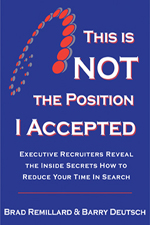
The first comment I get from candidates when I suggest these things is, “My resume will be too long.” No, it won’t. I have prepared thousands of resumes and I can get all of this on two pages. In fact, in our book, “This Is NOT The Position I Accepted” (CLICK HERE to review)  there is an example of a two page resume that contains all of this information. The person has over 20 years experience, so it is very doable.

Getting in the “A” pile is your responsibility, not the reader’s.

I wish more candidates would help us help them. All you have to do is give us the information we need to call you.

Contrary to what you may think, recruiters want to fill the position just as badly as you want the position.

For a FREE example of a cover letter CLICK HERE.

For a FREE example of a Thank You letter CLICK HERE.

For many more FREE resources and articles, join our Job Search Networking Group on LinkedIn. 4,300 people have done this. CLICK HERE to join.

I welcome your comments and thoughts.

Brad


Never Waste A Thank You Letter Saying Thank You

After an interview, sending a “Thank You” letter is common etiquette and a nice thing to do, but saying “thank you” should not be the main reason for sending it. Most candidates send one after interviewing with a company, but as a recruiter, I rarely receive one. I personally don’t need one, but on the occasions when I have received one, I think the candidate misses a great opportunity by just saying, “Thank you for the interview.”

I believe a good “Thank You” letter should be used to reinforce your ability to do the job and/or address any potential issues that came up during the interview. It can be another marketing document. It is important not to over do it, but a tactful letter, that does some subtle marketing can have a big impact on the person reading it.

For example, a few years ago a candidate called me after an interview and said, “I think I blew the interview.” The CEO asked me, ‘What my career plan is for taking this position?’ I answered how over the next few years I would impact my department and how that would impact the company. The CEO responded, “That is fine, but we really want people that want to grow and maybe some day have my job.” The candidate asked me what would be the best way to recover from this or if there was a way to recover. The answer was the, “Thank You” letter.

A carefully worded, “Thank You” letter explained to the CEO that the candidate interpreted the question as asking for the short term impact he would have once on board. He went on to explain, in the “Thank You” letter, that certainly in the long-term his desire was definitely to advance, but he realized that was dependent upon him doing an exceptional job in the role he was being hired to fill, hence the reason for answering the question as he did.

The candidate had the opportunity to address a miscommunication during the interview, which is a common problem with interviews. Ultimately, the candidate did get the job. Would he have gotten it anyway? Hard to tell. One thing is certain, the candidate didn’t think he would have.

Some other basic issues regarding a “Thank You” letter:

  • One page maximum
  • Send shortly after the interview
  • Not an email (with the possible exception of IT professionals)
  • Addressed to a specific person, not “Dear Interviewer” or salutation left blank
  • Individualized to the particular interview, personalized to the specific topic
  • Do not use a generic one-size-fits-all thank you letter

Consider using this as one more chance to market yourself. Don’t over do it. This is not the time for a hard sell. It must be subtle and tactful. It won’t work all the time, but hopefully as in the example, it will work the one time you really need it.

Download a FREE sample Thank You letter along with some Do’s and Don’ts for Thank You letters. CLICK HERE to get yours.

Join the IMPACT Hiring Solutions Job Search Networking group.  There are over 4000 members . JOIN BY CLICKING HERE.

We encourage comments and your feedback.

Brad Remillard