Posts tagged: Cover Letter Sample

Job Seekers and Warren Buffet

I am currently reading the book, “The Snowball: Warren Buffet and the Business of Life” by Alice Schroeder. It is an interesting biography on Warren Buffet’s life starting as a small child.  Some of the more interesting parts highlight what influenced his thought processes about everything from money to how he treats people.

I haven’t finished the book yet, but as I was reading it two sentences stood out. To me, these two sentences explained exactly why so many candidates stay in a job search so much longer than need be. I have known this for a long time. The candidates I work with one-on-one in our job search coaching programs often start out the same way.  I interview and speak with hundreds of candidates a month. It use to surprise me the number of people who acted this way. Not any more, I just accept it. I don’t understand it, but I do accept it.

When Warren was a teenager he read the book, “How to Make Friends and Influence People” by Dale Carnegie. Just about everyone has heard of this book.  His biography addresses the impact this book had on him. How it “honed his natural wit, above all it enhanced his persuasiveness, his flair for salesmanship.” Obviously, this one book influenced him so much that decades later he still remembered it and gave it credit.

It was  the two sentences before this which stood out and relates to the vast majority of candidates I encounter. Alice Schroeder writes, “Unlike most people who read Carnegie’s book and thought gee, that makes sense, then set the book aside and forgot about it, Warren worked at this project with unusual concentration; he kept coming back to these ideas and using them. Even when he failed and forgot and went for long stretches without applying himself to the system, he returned and resumed practicing in the end.”

This is what grabbed my attention. As soon as I read it, I thought this is exactly what most candidates do. This is exactly why so many candidates spend so many extra months searching for a new positions. They read a book, attend a webinar,  read a blog article or listen to an audio file and think, “Gee, that makes sense, then set it aside and forget about it.”

Few, my guess less than 10% do as Warren did. Read the sentences again. Does anything stand out to you as it did me? What did Warren Buffet do different than all the others?

I see this constantly.  People will return our job search workbook with a note, “Already know all this stuff.” At first I was stunned. When we wrote the book we spent an extensive amount of time identifying the mistakes candidates continually make. We  then worked extremely hard to provide solutions  to those mistakes. So it struck me as strange, that so many people knew all these mistakes, but just kept making them. How could this be?

I’m sure the many other excellent authors of books on this subject have experienced the same thing.

So I decided to test if it was true these people really did know all this stuff. I started doing some follow-up. I would call the person and ask for feedback. As I got bolder, I became more direct. I started asking very specific questions of those that “already know all this stuff?” For example, I would ask:

  • Since you already know the only three things which can be measured during a phone interview, what do you do to properly prepare?
  • As you know, there are only three types of questions asked in an interview. How do you identify which type of question is being asked and how do you prepare for each type of question?
  • Of the ten most important questions to ask in an interview, which ones in your opinion were most helpful and of those which ones do you use most often?
  • How long have you been using the cover letter we recommend and what has been your experience with this style?
  • How often have you found yourself in anyone of the 5  positions in the Circle of Transition and how do you handle it? This could be really helpful to other candidates?
  • How is your networking business card different from your interviewing business card?

It didn’t take long to discover these people may have read the book, but unlike Warren Buffet, they didn’t embrace the ideas with “unusual concentration.” Instead it was, “Gee I already know this stuff.”  When in fact, from their answers, they had no idea what mistakes they were making and how the book provides solutions.

Warren Buffet read Dale Carnegie’s book over and over again. He referred back to it time and time again. He practiced regularly. When he failed it was back to the book. That is what made him unique. He didn’t just know it all, he implemented the concepts. He didn’t blame the book when things went wrong, he adjusted and tried again.

I know from the one-on-one job search coaching we do, when we get candidates to stop knowing everything and start doing things the right way, they find job leads that eventually lead to offers and employment.

Although it might appear as an attempt to sell our book it really isn’t. There are many great resources available to candidates. Many are 100% free. It is positively an attempt to get candidates to stop saying, “Gee, that makes sense, but I already know it.” It is positively an attempt to get candidates to learn from Warren Buffet. To get candidates to refer back time and time again to excellent resources. To re-read the books, re-listen to the audio recordings and to take this advice to heart with “unusual concentration” as Warren Buffet did.

I have discovered the reason there is so much written for job seekers is because job seekers need so much help. If candidates did everything so perfectly there wouldn’t be a need for all the books, blogs, articles and webinars.

The next time you read anything designed to help you in your job search don’t let your first thought be, “Gee, I already know that.” Rather force yourself instead to ask, “Good advice. How am I implementing that in my job search?” Attack it the same vigor and “unusual concentration” as Warren Buffet.

Try this approach first and you will find yourself gainfully employed a whole lot sooner.

OK, now this is a blatant attempt to sell you a book. You can get our job search workbook to review for free. Just pay the $5 shipping. For details on this offer CLICK HERE.

Test your job search effectiveness by downloading our free Job Search Plan Assessment Scorecard. Find the strengths and weaknesses in your job search. Then attack the weaknesses with “unusual concentration.”  CLICK HERE to download.

For a FREE example of a cover letter that recruiters, HR and hiring authorities  like and will get your resume read, CLICK HERE.

I welcome your comments, thoughts and feedback.

Brad Remillard

How Recruiters Read Resumes In 10 Seconds – Audio Recording

Recruiters screen your resume in less than 10 seconds for a few very simple reasons. Do you know the top 5 reasons why a recruiter will toss your resume into the circular file after a quick glance? Are you making simple mistakes and errors that consistently get your resume thrown into the trash? Learn how to overcome those resume mistakes that are preventing you from being interviewed.  In this radio program, Brad and Barry dissect, discuss, and recommend improvements to overcome the most common resume mistakes and errors that permit recruiters to read your resume in less than 10 seconds

You can read a complete and very detailed article on this topic. CLICK HERE

To download or listen to this recording CLICK HERE, then scroll down to the recording.

5 Most Frequently Asked Job Search Questions I Receive

On Friday’s from 9 – 10 AM PDT we often conduct free “Candidate Open Forums.” These are conference calls open to all of our candidates, in which we discuss topics and answer questions directly from you – our candidates. Unfortunately, we are limited to 50 people on the line at one time, so often we can’t get to all of the questions submitted ahead of time via email.

We believe these are important, so from time to time in this blog we will discuss the topics and questions we, 1) don’t get to during the conference call, 2) are asked over and over again (so these are probably on your mind too), and 3) just consider important for you to know.

Remember, we are retained executive recruiters so the answers and thoughts come strictly from that perspective.

1) Chronological vs. functional resume? Easy answer – NEVER, NEVER, NEVER, use a functional resume. In my almost 30 years of recruiting I have never had any recruiter or hiring manager support the functional resume. I have also been on many panels where all of the panelists agree to NEVER use a functional resume. Functional resumes just scream out,”Try to figure out what I’m trying to hide.” See our free audio file on resumes.

2) How do we overcome negatives such as age, turnover, time between jobs, etc? We believe you address them head on. If you have a negative, avoiding it doesn’t make it go away. We have a blog entry “Preemptive Strike” which you should also consider reading. If you have a negative item, you should bring it up straight away, discuss it openly and then whatever happens, happens. Don’t assume, “They didn’t bring it up so it must not be a problem.” They didn’t bring it up because they already settled it in their mind. You need to preempt any preconceived ideas before they come into play.

3) What is the best method and frequency for following up on a resume? For us, as recruiters, we prefer via email or one of the social media forums, Linkedin or Twitter. Recruiters have reduced staff just like many other companies, while the number of calls from candidates has skyrocketed. It isn’t possible to call every person. Email allows us to reply late at night, on weekends, or even while waiting in the lobby of a client. I can’t do that with phone calls. Regarding frequency, if in fact you are dead on perfect, then after two weeks send a follow-up email.

4) With so many top level executives in the market, how do you differentiate yourself from the pack? This is the 64,000 dollar question. We believe the best answer is to have a very compelling resume which is targeted specifically to the position. A generic, one size fits all resume will not differentiate you. That is what “generic” means. In today’s market our clients and therefore recruiters, are seeking very specific backgrounds. We are not looking for the proverbial, “Jack of all trades,” we are looking for the, “King or Queen for a specific role.”

5) Is negotiating with the employer different today due to the economic situation, and if so how? There is a difference given today’s market. For example, most companies will not relocate today especially in a large market area. Also, companies tend to be closed to severance agreements. If you aren’t working, they figure there is no reason to give an agreement and they are in control. You have to pick your issues and know where to compromise. This is all part of the pre-planning process for a job search. What issues will you compromise on and which ones should you dig in your heels?

You can download a free 8 Point Job Search Plan Self-Assessment that will help you evaluate exactly what you need to do to improve your search. CLICK HERE to download.

Is your Linkedin Profile going to get you noticed. Our FREE Linkedin Profile Matrix will help you develop an outstanding profile. CLICK HERE to download yours.

Join our LINKEDIN Job Search Networking group. Over 4200 people have joined. CLICK HERE to join.

We realize not everyone will agree with these answers and that is healthy. So if you don’t agree, or wish to comment, we encourage you to do so. Just click the link below.

Brad Remillard

2 Simple Questions I Asked 10 Job Seekers And They Failed

This is why recruiters and hiring managers get frustrated with candidates. For the most part this demonstrates why most candidates fail the interview. Candidates leave an interview thinking all went well, when in fact, the candidate is not going to be asked to come back.

It also demonstrates why candidates need to consider investing in their job search. There are many great resources available to ensure candidates conduct a really effective and professional job search. In today’s economy a job seeker can’t afford (literally) to be anything less than 100% effective.  Unfortunately, none of these 10 will get the job. If they had invested less than $100, I believe they could have properly answered these simple questions.

Instead they will spend more time looking, ultimately costing them thousands of dollars. Who knows when another opportunity will come up.

So here are the two simple questions I asked the senior executives.

1) Do you consider yourself to be a person who demonstrates high initiative on a regular basis? All 10 basically answered, “Absolutely.” Not just “yes”  but “absolutely.”

The obvious follow-up question to me is:

2) Can  you give me a specific example  where you demonstrated high initiative in your current or most recent role? This is where the interview collapsed. Not one could give me an example of high initiative. All 10 either  rambled on and on hoping I would forget the question or the example was what I would normally expect them to be doing as part of their job. Not HIGH initiative.  Not one could provide an example of something they claim to do on a regular basis.

Basically they were not prepared. They all answered positively expecting that to be the end of it.

If they claim to “absolutely” demonstrate high initiative on a regular basis, I would expect them to have at least one example. That doesn’t seem like a trick question to me.

Why these candidates were not able to answer this simple question is beyond me. I can only think, like many candidates, they thought, “I will just wing it.” Proper preparation isn’t all that important.  The key word is, “proper.” They may have prepared, but obviously not the right or effective way.

I wonder how many times a day a candidate blows the interview or a candidate’s resume gets screened out for something simple.  How many candidates are still searching only because they refused to invest  in their job search. In the same way,  many people  invest in anything they want to become proficient at, including piano lessons, golf lessons, tennis lessons, lessons to learn a software program, etc. investing in a job search is just as critical. I believe  a lot more critical.

Every extra day in a job search is costing these people thousands.

So what can you do  so it doesn’t happen to you:

1) The internet offers an endless amount of free resources for all to tap into.

2) Not all resources are right for every person. Some may be more appropriate for technical people, some for non-professionals or for professionals, and some are primarily focused at managers and above. Search until you find a resource that fits  your needs. Like most things job search resources are not one-size-fits-all.

3) Once you find a resource take full advantage of the free offerings. Read the blog articles, listen to any audio files, if the offer free webinars attend them. Use these free resources to the fullest extent you can.

4) Only after you trust them and recognize they are right for you, don’t be afraid to invest a few bucks. Nobody can possibly give away everything for free. They  have to make a living too.  Since you have already engaged them and trust them purchasing a book, CD,or  attending a paid webinar will be worth every penny. Many won’t even charge you until  you are completely satisfied or offer a money back guarantee. That takes away any risk of wasting money.

5) Seek their help with your resume or interviewing skills. Many will give you a first pass for free. Again, if you trust them investing a few bucks may make the difference between getting a job and not getting a job. I know it would have helped these ten people.

The best thing you can do for your job search is to make sure you don’t lose an opportunity because of a simple mistake. In this economy it may be a while before another opportunity comes along.

To practice what we preach, we offer an enormous amount of free resources for you to take full advantage of.  I encourage you to use these resources as often as you like and to their fullest extent. For example:

1) Our extensive audio library recordings from our weekly radio program on www. latalkradio.com CLICK HERE to review the program listing.

2) Our FREE sample cover letter. Over 2000 people have downloaded this. CLICK HERE to download yours.

3) Our FREE Linkedin profile assessment. Build a great profile on Linkedin. CLICK HERE to download yours.

4) Over 4000 people have joined our Linkedin Job Search Networking Group. CLICK HERE to join.

5) Download a free chapter from our job search  book on phone interviewing tips. CLICK HERE to download.

6) These are just a few of the free offerings on our website. There are many more for you to take advantage of without buying anything.

FULL DISCLOSURE. Yes, there are products to buy on these pages. If this is your first time you should check out the free stuff first. If those are helpful and you still need help then you can check out the products. We offer most of them on a free trial basis. You don’t have to buy anything until you are sure it will help you.

We want to be a resource for  you in your job search. Our goal is the same as yours. We want to help you spend as little time in a job search as possible.

I welcome your thoughts and comments.

Brad Remillard

It’s play-off time for your job search – what do you have to lose?

Are you conducting a job search like it's the last 5 minutes of your championship play-off game?

Here comes another basketball metaphor about your job search.

A few nights ago, my Varsity HS Girls Basketball Team played in the first round of the State Playoffs. In our section we were ranked 6th out of 32 teams. We played a team ranked 24 and almost lost.

Why? It should have been an easy win – a no-brainer.

At playoff time, teams change – they go from being conservative, playing careful, doing the same old thing, and usually playing within their capability. At playoff time, lower ranked teams hike it up to whole other level. They play with complete abandon – and give it a 110%.

What do the lower ranked teams have to lose? If they don’t win, their season ends right now. And if they can pull off one more win – they get to come back and play another game. Many upsets occur, because lower ranked teams fight as hard as they ever fought, they do everything they can to influence the outcome, and they leave nothing on the table.

If you asked the team last night that lost to us in the last 5 minutes of the game if they had any regrets – if any of the players felt they had not played as hard as they could – and the answer would be an overwhelming “I gave it everything I could”.

When asked that question, our higher ranked girls would have said there was a lot they could have done and they were disappointed in their performance since they didn’t “work hard enough”. They were coasting on their high ranking, thinking their past track record could speak for itself.

Are you guilty of this dysfunctional thinking in your job search?

If you ask most candidates that question about their job search, I would predict that most candidates would have significant regrets about their commitment, energy, and intensity regarding their job search.

Most candidates are not willing to “go beyond the call of duty” in their job search.

Most candidates could not claim that they have “outworked their peers” in their job search.

Most candidates are just doing the same thing over and over (Benjamin Franklin’s Definition of Insanity).

No wonder the typical executive/senior management job search is now significantly over 6 months. Here are some questions to ponder about your job search:

  • What are you doing in your job search that your peers are unwilling to do?
  • What are doing this week that represents a high level of energy, commitment, and intensity in your job search than last week?
  • How would you quantify the effort and intensity of your job search?
  • Shouldn’t you be treating your job search like it’s play-off time and it’s the last 5 minutes of what could be the last game of the season or your entire career?
  • Are you going beyond the call of duty in your job search?

What could you be doing differently that would represent a higher level of commitment, energy, and intensity?

This is just a small list of the hundreds of things you could be doing in your job search to reduce the time it takes to find a great opportunity. Most of your peers are unwilling to invest the time to do these job search best practices. Are you willing be to do what it takes to win – to go beyond what most of your peers do in their job search – or would you rather coast in the middle of the pack?

Have you downloaded our FREE Job Search Preparation Scorecard to see if you’re doing everything you can to conduct an effective job search?

What’s holding you back from pouring everything you’ve got into your job search?

Barry Deutsch

Jump into the Questions and Answers in our popular LinkedIn Discussion Group to discover what some candidates are doing that truly represents an effort to go “beyond the call of duty”.

Don’t Be the Candidate Screened Out by a Recruiter’s First Question

Candidate being REJECTED after the first interview question - Don't let this happen to you

In my last blog post, I described how the best recruiters screen out the vast majority of candidates for their search assignments through one simple question.

Don’t be the one who gets screened out in 30 seconds.

Many times these are great opportunities the recruiters are working on – you’re the perfect candidate for that appropriate position – you definitely do not want to miss out.

What can you do?

I’m going to suggest that there is a simple approach you can use to prepare for interviews, and it mirrors the cover letter strategy.

If the advertisement does not point out precisely what is required in the position, you can make the fair assumption that there are 3-4 primary elements to every senior professional, managerial, and executive position. Putting your comparable accomplishments to each of these core elements of a position in the cover letter, and being ready to address them in the interview is an insurance policy against being screened out prematurely by recruiters.

Let’s run through a few examples:

If you are applying for a CFO/Controller/Director of Finance position in an entrepreneurial to mid-sized non-public company, the primary expectations over the first year will probably include:

1. Process Improvement – reducing the closing process, improving financial reporting, inventory control process changes, order entry processing speed/efficiency.

2. Financial Planning/Analysis/Forecasting – improvements to budgeting, annual planning, cash flow management, strategic planning, monthly analysis, monthly and quarterly projections.

3. Operational Projects – conducting special one-time analysis on leasing equipment, facility optimization, capital investments in equipment, customer profitability analysis, viability of new products, services, markets, analysis of warranty reserves, and cost reduction opportunities.

4. Policies/Procedures/Asset Protection – improving/changing the handling of cash, tracking of fixed assets, credit policies, collection management, purchasing and material management.


If you are applying for a Marketing Manager position at a sub-component manufacturing company, the primary expectations over the first year might include:

1. Marketing/Sales Materials – review and improvement of all collateral material used by the sales team.

2. Business Growth – assessment and recommendation of new markets, products, and services. Launching and managing existing and new services and products.

3. External marketing – branding, positioning, messaging, advertising, and trade shows to increase awareness and recognition in marketing to OEM manufacturers.

4. Lead generation for the sales function – database marketing, trade offers, channel management, website, lead management tools.


Tell us what the 3-4 primary success factors are in your functional role for the type of industry/type of company that you are focusing your job search on.

We’d like to see how many job seekers understand the critical components of being successful for the type of position they are seeking.

Now let’s jump back to the first interview question a recruiter poses to you in the initial phone call:

My client’s closing process takes too long. They need this individual to reduce by 50% the time it takes to close their books on a monthly basis.

Amazing. Astounding. The recruiter is blown away. You’ve got 2-3 great examples of where you solved similar/comparable process problems/obstacles.

Let’s try another one:

My client is looking at expanding their regional electro-optical sub-component business nationally. Do you have 2-3 comparable examples you could share about moving a company into different markets against entrenched competition?

Amazing. Astounding. Once again the recruiter is blown away by the 2-3 examples you’ve shared about successful marketing efforts to move your prior companies into new markets.

The recruiter is doing their job asking the tough questions based on client expectations of success. A little preparation and understanding of what the most common obstacles/problems/opportunities someone in a specific role is going to face will allow you to ace the vast majority of “appropriate” interviews.

Keep in mind that if your background is primarily in marketing management and you’ve done very little in sales management, I’m probably going to quickly screen you as inappropriate for this executive search for a sales management job. If you’re essentially a channel marketing director, I’m probably going to quickly exclude you from consideration for the marketing role in my client’s direct sales model.

The key word is “appropriate”.

One of the greatest frustrations we hear from employers/recruiters is that the vast majority of candidates from whom the receive resumes/calls ARE NOT APPROPRIATE” for their openings on a very basic level – this brings us back to a previous blog posting where I made the outrageous suggestion to stop shot-gunning your resume to jobs that are totally inappropriate and focus your search efforts on “appropriate jobs”.

The shot-gun approach to responding to job advertisements/recruiter job announcements is a complete waste of time. Okay – a miniscule number of candidates will occasionally get lucky – after all – even a blind squirrel will get a nut sometimes. However, do you want to base your job search on “luck” or on a systematic – methodical – structured approach validated as generating consistent results?

You make the choice! If you’re not obtaining decent results from your current shot-gun approach of scattering resumes every time you come across a key word – perhaps it’s time to try a test and see if a more focused effort would generate better results.

Now that I’ve repeated myself for the 100th time on the worthless approach of conducting a shot-gun job search, let’s return to the primary focus of this blog post.

Let’s assume you get screened out for an “appropriate” role.

Shame on you for letting that happen.

If you’ve taken all our recommendations in our FREE Archive of job search best practices including such items as preparing a great job search plan, developing an outstanding LinkedIn Profile, consistently and effectively leveraging cover letters, and investing extensive time in the preparation for an interview – then there is NOT a recruiter, HR staff person, or Hiring Manager who CAN deny you the opportunity to be considered.

NOW we come to the real issue behind why you get screened out for “appropriate” openings on the first recruiter interview question (forget all the  “inappropriate job responses” – you should be immediately screened out for these) – you didn’t do your homework – you didn’t apply the best practices in conducting you job search -  you basically “winged-it”.

STOP being screened out prematurely for openings for which you are perfect. STOP letting this happen. Make a resolution right now that you will never allow yourself again to be screened out prematurely for an “appropriate” position.

START today in changing the way you conduct your job search. Take our entire FREE Archive of Audio Programs, Templates, Examples, and other tools – and start transforming your job search. After you swallow that overwhelming amount of FREE content from us – start extracting the FREE content from all other great career coaches and recruiters on the internet.

STOP complaining about your ineffective job search and the obstacles you are facing. There is an extraordinary amount of great content available to you that is either FREE or can be acquired for a minimal investment. Every candidate I have met in this horrific job market that invested time in discovering and using job search best practices has dramatically reduced the time it took to land a great job.

WHAT IS HOLDING YOU BACK?

DO YOU FEEL YOU KNOW EVERYTHING THERE IS TO KNOW ABOUT CONDUCTING AN EFFECTIVE JOB SEARCH?

ON A SCALE OF 1-10 (10 BEING THE HIGHEST) ARE YOU DOING EVERYTHING YOU COULD BE DOING TO CONDUCT A MORE EFFECTIVE JOB SEARCH.

In this blog post, we just took one tiny element of conducting a more effective job search: How to NOT get screened out by recruiters for appropriate positions in their first interview question.

There are hundreds of activities, tactics, strategies you could use to conduct an effective job search.

Barry Deutsch

Jump into the vibrant dialogue in our LinkedIn Job Search Discussion Group on the most common basic best practices of conducting an effective job search.

5 Tips How To Keep Your Resume Out Of The Black Hole

Candidates constantly complain about how when they email resumes they all seem to end up in the proverbial “black hole.”

As a recruiter, who receives on average 6 to 7 hundred resumes a week, I can understand your frustration. I’m also sure I may not be able to eliminate it, however, I hope I can help you reduce it with these few tips.

1) When you move from candidate to hiring manager remember your frustrations and treat the people sending you resumes as you want to be treated now. You know, the thing our parents always taught us about treating others the  way we want to be treated. Sounds so obvious but I just wrote another article about how rarely this happens.

2) The best way to avoid the black hole in the first place is not enter it. If you include a cover letter; a) don’t send it as a separate attachment to your resume. It should be the first page when the resume attachment is opened. b) use either Word or PDF to send your resume. I receive many resumes I can’t open. c) your cover letter should be designed to grab the reader’s attention. That means the cover letter must clearly and with a simple glance align your background with the needs of the job. CLICK HERE and download a free copy of a sample cover letter that does just that.

3) You don’t have to be the first resume received. Most ads run for at least 30 days. Many candidates have experienced most companies take their time. So wait a few days or even up to a week or more before replying. Avoid being one of the first 400 resumes. After the first blast of resumes come, as more trickle in one or two at a time, I will often just open the resume take a look at it and make a decision how to handle it. These people avoided the rush and got their resume reviewed.

4) First try the personal approach. With number 3 above in mind, use this time to try and find a personal connection within the company or recruiting firm. There are many ways to do this. 1) Linkedin should be first on your list. This is  exactly why you need to build your connections to the maximum number possible. 2) Google the person’s name, position, or company name, anything that will help you target the right person within the company. Then look for a personal introduction. Most recruiters value a referral.

5) Don’t use services that blast your resume to 10,000 recruiters and/or companies. This is a major waste of money. What do you expect will happen when someone receives a bunch of unsolicited resumes? What would you do with them? How do you handle unsolicited emails? Most call it SPAM. It doesn’t work.

Hope these tips are helpful and now your resume will at least pop to the top.

Designing a resume is the starting point of every job search. If your resume gets screened out it is worthless.

If you didn’t know these little tips our Complete Resume System is designed to make sure your resume gets noticed. We guarantee it. The hundreds of people who have used this system to build an effective resume are getting their resumes read. You can too. There are many more tips you should include in your resume. For more information about getting your resume noticed check out our Complete Resume System. CLICK HERE to view it.

You should join our LinkedIn IMPACT Hiring Solutions Job Search Networking Group. It is free on LinkedIn and there is an enormous amount of articles and discussions to help in your job search. That is why over 4000 people have joined so far. CLICK HERE to join if you are a LinkedIn member.

You can also download for FREE a sample cover letter to use that will align your background with those of the company. CLICK HERE to download your sample.

I welcome your thoughts and feedback.

Brad Remillard

3 Simple Absolute Musts In A Job Interview

Interviewing is an art more than a science. Like most art, there are the Van Gogh’s and then there are those that work hard but never reach a professional level. They may still be good, just not good enough.

I think that is the way most candidates approach the interviewing process. They think they are good, when in fact, most are not good enough. This is especially evident when a candidates tells me, “I’m getting interviews but just not getting the job.”  To me, that rings out loud and clear, you need to take a look at your interviewing skills.

Here are three things I find missing with candidates in an interview.

1) Confidence I find this lacking, especially with candidates that have been in a job search for a long time. As they become more and more desperate they tend to exude less and less confidence. This comes across in a number of ways that I believe most candidates don’t even realize. For example, body language,  how you sit in the chair, eye contact, tone of voice, confidence in answering questions, staying so general in the answer for fear that getting too specific or detailed may rule you out, or giving long rambling answers so as to encompass everything in the hope that you have covered what they are looking for.

Nobody wants to hire a person that isn’t confident. This is especially true at the manager level and up. Few want someone that comes across so weak they will not voice an opinion.

With candidates I coach, I always recommend  interviewing the same way you would if you had a great job and didn’t need the one you are interviewing for. I believe this helps in bringing out the real you. Most candidates act differently on the job than in an interview, so it is very important that the interviewer sees you as you would be on the job.

2) Questions In many ways this is a symptom of confidence. Why is it when an interviewer asks, “Do you have any questions for me?” candidates often say, “No not right now.” I don’t understand that.  This clearly demonstrates weakness, lack of interest, or lack of understanding of the position, any of which gets one knocked out of the running.

This is your opportunity to shine, to demonstrate your depth of understanding, to probe, to engage, get clarification, and basically stand out. I think one of two things stops candidates from asking questions; 1) fear that they may appear to be too confrontational or challenging or 2) lack of preparation. Either one is generally not going to help the candidate win the interview.

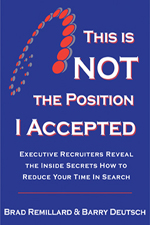
All candidates should be well prepared with questions. There are so many areas that  you can ask good questions about that will help separate you from all of those that don’t. This is so important that in our candidate job search workbook  “This Is NOT The Position I Accepted” we have over 135 questions to ask in over seven different categories. That demonstrates the importance of asking questions in the interview.

3) Preparation This is probably the solution to the first two.  Taking the time to properly prepare is the biggest problem I have discovered over and over again that candidates fail to do or do properly. Poor preparation is just as bad as no preparation. Here are some stats I have been keeping as I have asked candidates about their preparation.

A) Less than 5% of candidates have actually written out answers to the most basic questions that they know will be asked in an interview.

B) Less than 1% have actually video recorded themselves interviewing.

C) Less than 1% have conducted mock interviews.

D) Less than 10% prepared questions they wanted to ask during an interview.

E) Less than 20% have asked others for feedback after an interview that they didn’t get.

F) Less than 10% have identified any weaknesses in their interviewing style.

G) Less than 2% know all of the three things that can be measured during a phone interview.

H) Less than 10% can give very detailed answers about the bullet points on their resume.

I) Less than 1% have even considered body language in preparing for an interview.

J) Less than 5% prepare for an interview the right way.

K) Less than 50% know they have a weak handshake or poor eye contact.

Not everyone makes all of these, but to my surprise most make many of them. This is why candidates are often not good enough at interviewing.

You can get our Candidate Job Search Workbook for FREE (just pay $5 shipping). You can review the questions, read the multiple chapters on interviewing, and even learn the ten must ask questions in an interview. CLICK HERE to learn how to get your workbook sent to you for just the cost of shipping.

Download our sample cover letter. This will help make sure your resume aligns with the position, and recruiters appreciate this style. It is free.  CLICK HERE to get yours.

Finally our LinkedIn Job Search Networking Group is free to join and all are welcome. This group has over 3,800 members and a wealth of articles, job postings and discussions to help you. CLICK HERE to join the group.

I welcome your thoughts and comments.

Brad Remillard

Does Your Resume STINK? Is that the problem?

Holding your nose because your resume stinks

Did you know that the number one reason most candidates don’t get called for an interview after submitting a resume is that their resume and cover letter STINKS?

Reminder – LAST CHANCE to take Advantage of our Special One-Time Resume and Cover Letter Webinar tomorrow — Friday – January 29th – Special Appreciation Rate and Bonus Materials


If you’re not getting a high number of “bites” on your resume when you forward it to networking contacts and submit it to employers for their job postings, perhaps the problem is not so much with the economy – but rather in the document you’ve created to market yourself.

Can you afford to have a resume and cover letter that STINKS?

No wonder the average time for a manager or executive to find a job is creeping beyond 6 months into the 12-18 month plus time period.

How many months will you continue to deplete your savings account and base your job search on hope and luck by using a resume and cover that STINKS?

We’ve put together a very special webinar for the members of our job search community. One hour is all it takes to learn how to create a powerful marketing document that grabs employer’s attention and makes them want to pick up the phone and call you.

The best news is that we’ve cut the price in half for our loyal readers and followers and we’ve thrown in a few HOT items that will help your job search. You’ll NOT find a less expensive webinar packed with as many ideas – tactics – and helpful advice anywhere on the Internet.

Learn the inside secrets of creating and leveraging a power marketing document to get interviews and finish your job search quickly.

Join us for this webinar (probably will only be offered ONCE this year) which is special appreciation webinar for our job search community of loyal readers and followers.

Click the link below to take advantage of this unique private offer to our job search community reducing the normal fee for the webinar from $89.95 to $39.95 and the inclusion of two of our HOT audio programs – a total value of over $150.00.
Last chance to sign up TODAY. Click this link to register now:


SIGN UP-GET MORE INTERVIEWS WITH YOUR RESUME

Join me on Friday January 29th at 9 AM to start conducting an effective job search NOW!

Barry Deutsch

Photo courtesy of megngarnett

HELP, Resumes Keep Coming In. What Should We Do?

I received 347 resumes just this week. On a weekly basis this is about average. Some weeks I get more, some weeks less, but over time 300 or so is not unusual.

Many of these resumes were received for a search directly via email, about 10% via snail mail, another 15% from referrals and another 15% completely unsolicited with candidates just introducing themselves.

Of these, maybe half to two-thirds had cover letters. Of those with cover letters, about 80% were worthless and I didn’t even take the time to read them. Why, because they all were almost exactly the same. As they say in the movies, “Only the names had been changed.” The other 20% I did take the time to at least scan them looking for points that might align with a current search or that at least piqued my interest.  These 20% were different in that they were not long paragraphs that simply regurgitated the resume,  but instead most were either bullet points or the two column type we recommend using and have a free sample available for all to download. (CLICK HERE to download). They were easy to scan to pick up the highlights and decide how to properly handle the resume.

Although I really don’t care one way or the other if a resume has a cover letter or not, but if a candidate is going to include one it should add value by intriguing the reader enough to look at the resume. If not, why include it?

I believe this is why most cover letters are ignored. They all look alike and do nothing to make the reader want to take a look at your resume, so the recruiter, HR, or hiring manager completely skips over them.

Of the 347 resumes, most were a complete waste of time to even review. Sorry, I know candidates don’t want to hear this, but sometimes the truth hurts.  Sending me a resume when I don’t have an active search is not going to help you. As a retained recruiter, I work the searches I have and that is my focus.  If your resume doesn’t match my clients needs then I rarely save it. Not because you aren’t a qualified person, not because you don’t have great experience, but because after 30 years of this I know the profile of candidates that I place.  If you don’t meet that profile, I don’t need your resume regardless of your experiences and abilities.

This is true of most recruiters.

I recently heard from a candidate complaining that he had sent out over 200 resumes and had heard back from only 5. Actually that isn’t bad. Mass mailing resumes is a waste of time and money. It is a complete crap shoot that anything will stick. I advise all candidates to never do this.

The best way to get your cover letter and resume noticed is to be very targeted and focused, especially with recruiters. We want to fill the position as badly as you want the position.  From my perspective, if your background is consistent with my client’s needs and you meet the basic criteria I outlined in the article, How Recruiters Read Resumes In 10 Seconds (CLICK HERE to read), you will get a call from me usually within an hour.

Those 10% that were referred to me I responded to. I always respond when a person is referred to me, even if I can’t help them. I appreciate referrals and want to respect the person that made the referral. In my opinion this is the best way to get a recruiter that you don’t know to engage you.

The unsolicited resumes were put into a file that when time permits I will review. If they meet the profile of the type of candidate that I have a high probability of placing in the future, I will add them to our database.

My partner Barry and I have written extensively on what we believe is the best way to get your resume noticed by recruiters, HR, and hiring managers.  These recommendations come from over 30 years of experience as recruiters, from asking hundreds in HR what they use as screening criteria, and from thousands of hiring managers, CEOs and key executives telling us how they review resumes. Barry and I try to pass this information along to all so it will be helpful and reduce your level of frustration by knowing what to expect when you send out a resume.

One more way we can help you is to speak directly with you utilizing our webinars.  Our time and knowledge is valuable so YES, we do charge a nominal fee for the webinar. To balance that, we also offer a lot more tools and resources for FREE than what we charge for.

We’ve DEEPLY DISCOUNTED THE WEBINAR FOR THOSE JOB SEEKERS WITHIN OUR JOB SEARCH COMMUNITY – loyal followers on Twitter, readers of our blog, and members of our LinkedIn Job Search Discussion Group.

In a lively one-hour presentation, I’ll show you the inside secrets (from a retained executive recruiter’s perspective) of how to get your resume reviewed every single time and boost your resume acceptance rate (the number of times you get called for an interview from submitting your resume) from a dismal level of less than 10% to well into the 50% PLUS RANGE. If you’re reading this blog, when you sign up for the Webinar use the coupon code of IMPROVEMYRESUME.

If the small, inconsequential, almost non-existent fee for the webinar is too much to bear to boost your resume acceptance rate and cut your job search time dramatically, please feel free to download our many FREE resources for job seekers, including our radio show broadcasts, cover letter sample, and other tools.

I welcome your thought and comments.

Brad Remillard