Posts tagged: Job Interviews

2 Simple Questions I Asked 10 Job Seekers And They Failed

This is why recruiters and hiring managers get frustrated with candidates. For the most part this demonstrates why most candidates fail the interview. Candidates leave an interview thinking all went well, when in fact, the candidate is not going to be asked to come back.

It also demonstrates why candidates need to consider investing in their job search. There are many great resources available to ensure candidates conduct a really effective and professional job search. In today’s economy a job seeker can’t afford (literally) to be anything less than 100% effective.  Unfortunately, none of these 10 will get the job. If they had invested less than $100, I believe they could have properly answered these simple questions.

Instead they will spend more time looking, ultimately costing them thousands of dollars. Who knows when another opportunity will come up.

So here are the two simple questions I asked the senior executives.

1) Do you consider yourself to be a person who demonstrates high initiative on a regular basis? All 10 basically answered, “Absolutely.” Not just “yes”  but “absolutely.”

The obvious follow-up question to me is:

2) Can  you give me a specific example  where you demonstrated high initiative in your current or most recent role? This is where the interview collapsed. Not one could give me an example of high initiative. All 10 either  rambled on and on hoping I would forget the question or the example was what I would normally expect them to be doing as part of their job. Not HIGH initiative.  Not one could provide an example of something they claim to do on a regular basis.

Basically they were not prepared. They all answered positively expecting that to be the end of it.

If they claim to “absolutely” demonstrate high initiative on a regular basis, I would expect them to have at least one example. That doesn’t seem like a trick question to me.

Why these candidates were not able to answer this simple question is beyond me. I can only think, like many candidates, they thought, “I will just wing it.” Proper preparation isn’t all that important.  The key word is, “proper.” They may have prepared, but obviously not the right or effective way.

I wonder how many times a day a candidate blows the interview or a candidate’s resume gets screened out for something simple.  How many candidates are still searching only because they refused to invest  in their job search. In the same way,  many people  invest in anything they want to become proficient at, including piano lessons, golf lessons, tennis lessons, lessons to learn a software program, etc. investing in a job search is just as critical. I believe  a lot more critical.

Every extra day in a job search is costing these people thousands.

So what can you do  so it doesn’t happen to you:

1) The internet offers an endless amount of free resources for all to tap into.

2) Not all resources are right for every person. Some may be more appropriate for technical people, some for non-professionals or for professionals, and some are primarily focused at managers and above. Search until you find a resource that fits  your needs. Like most things job search resources are not one-size-fits-all.

3) Once you find a resource take full advantage of the free offerings. Read the blog articles, listen to any audio files, if the offer free webinars attend them. Use these free resources to the fullest extent you can.

4) Only after you trust them and recognize they are right for you, don’t be afraid to invest a few bucks. Nobody can possibly give away everything for free. They  have to make a living too.  Since you have already engaged them and trust them purchasing a book, CD,or  attending a paid webinar will be worth every penny. Many won’t even charge you until  you are completely satisfied or offer a money back guarantee. That takes away any risk of wasting money.

5) Seek their help with your resume or interviewing skills. Many will give you a first pass for free. Again, if you trust them investing a few bucks may make the difference between getting a job and not getting a job. I know it would have helped these ten people.

The best thing you can do for your job search is to make sure you don’t lose an opportunity because of a simple mistake. In this economy it may be a while before another opportunity comes along.

To practice what we preach, we offer an enormous amount of free resources for you to take full advantage of.  I encourage you to use these resources as often as you like and to their fullest extent. For example:

1) Our extensive audio library recordings from our weekly radio program on www. latalkradio.com CLICK HERE to review the program listing.

2) Our FREE sample cover letter. Over 2000 people have downloaded this. CLICK HERE to download yours.

3) Our FREE Linkedin profile assessment. Build a great profile on Linkedin. CLICK HERE to download yours.

4) Over 4000 people have joined our Linkedin Job Search Networking Group. CLICK HERE to join.

5) Download a free chapter from our job search  book on phone interviewing tips. CLICK HERE to download.

6) These are just a few of the free offerings on our website. There are many more for you to take advantage of without buying anything.

FULL DISCLOSURE. Yes, there are products to buy on these pages. If this is your first time you should check out the free stuff first. If those are helpful and you still need help then you can check out the products. We offer most of them on a free trial basis. You don’t have to buy anything until you are sure it will help you.

We want to be a resource for  you in your job search. Our goal is the same as yours. We want to help you spend as little time in a job search as possible.

I welcome your thoughts and comments.

Brad Remillard

3 Simple Absolute Musts In A Job Interview

Interviewing is an art more than a science. Like most art, there are the Van Gogh’s and then there are those that work hard but never reach a professional level. They may still be good, just not good enough.

I think that is the way most candidates approach the interviewing process. They think they are good, when in fact, most are not good enough. This is especially evident when a candidates tells me, “I’m getting interviews but just not getting the job.”  To me, that rings out loud and clear, you need to take a look at your interviewing skills.

Here are three things I find missing with candidates in an interview.

1) Confidence I find this lacking, especially with candidates that have been in a job search for a long time. As they become more and more desperate they tend to exude less and less confidence. This comes across in a number of ways that I believe most candidates don’t even realize. For example, body language,  how you sit in the chair, eye contact, tone of voice, confidence in answering questions, staying so general in the answer for fear that getting too specific or detailed may rule you out, or giving long rambling answers so as to encompass everything in the hope that you have covered what they are looking for.

Nobody wants to hire a person that isn’t confident. This is especially true at the manager level and up. Few want someone that comes across so weak they will not voice an opinion.

With candidates I coach, I always recommend  interviewing the same way you would if you had a great job and didn’t need the one you are interviewing for. I believe this helps in bringing out the real you. Most candidates act differently on the job than in an interview, so it is very important that the interviewer sees you as you would be on the job.

2) Questions In many ways this is a symptom of confidence. Why is it when an interviewer asks, “Do you have any questions for me?” candidates often say, “No not right now.” I don’t understand that.  This clearly demonstrates weakness, lack of interest, or lack of understanding of the position, any of which gets one knocked out of the running.

This is your opportunity to shine, to demonstrate your depth of understanding, to probe, to engage, get clarification, and basically stand out. I think one of two things stops candidates from asking questions; 1) fear that they may appear to be too confrontational or challenging or 2) lack of preparation. Either one is generally not going to help the candidate win the interview.

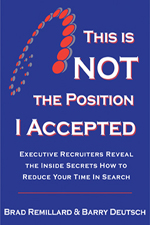
All candidates should be well prepared with questions. There are so many areas that  you can ask good questions about that will help separate you from all of those that don’t. This is so important that in our candidate job search workbook  “This Is NOT The Position I Accepted” we have over 135 questions to ask in over seven different categories. That demonstrates the importance of asking questions in the interview.

3) Preparation This is probably the solution to the first two.  Taking the time to properly prepare is the biggest problem I have discovered over and over again that candidates fail to do or do properly. Poor preparation is just as bad as no preparation. Here are some stats I have been keeping as I have asked candidates about their preparation.

A) Less than 5% of candidates have actually written out answers to the most basic questions that they know will be asked in an interview.

B) Less than 1% have actually video recorded themselves interviewing.

C) Less than 1% have conducted mock interviews.

D) Less than 10% prepared questions they wanted to ask during an interview.

E) Less than 20% have asked others for feedback after an interview that they didn’t get.

F) Less than 10% have identified any weaknesses in their interviewing style.

G) Less than 2% know all of the three things that can be measured during a phone interview.

H) Less than 10% can give very detailed answers about the bullet points on their resume.

I) Less than 1% have even considered body language in preparing for an interview.

J) Less than 5% prepare for an interview the right way.

K) Less than 50% know they have a weak handshake or poor eye contact.

Not everyone makes all of these, but to my surprise most make many of them. This is why candidates are often not good enough at interviewing.

You can get our Candidate Job Search Workbook for FREE (just pay $5 shipping). You can review the questions, read the multiple chapters on interviewing, and even learn the ten must ask questions in an interview. CLICK HERE to learn how to get your workbook sent to you for just the cost of shipping.

Download our sample cover letter. This will help make sure your resume aligns with the position, and recruiters appreciate this style. It is free.  CLICK HERE to get yours.

Finally our LinkedIn Job Search Networking Group is free to join and all are welcome. This group has over 3,800 members and a wealth of articles, job postings and discussions to help you. CLICK HERE to join the group.

I welcome your thoughts and comments.

Brad Remillard

An Absolute Must For A Job Interview

One of only three things that can be measured during a phone interview is communication.  The interviewer is determining how well you communicate and how well you will work with the management team. Communication style is critical to cultural fit. If you are thinking verbal communication, in this instance you are half right. Most candidates think we are talking about one’s use of the English language and proper use of verbs, avoiding the word “like,” being succinct, and all the other verbal components of communication. Generally you are correct, but not this time.

This time I’m referring to listening skills. This is also a component of communication. Before you click away, recognize that study after study revealed that most people are not good listeners. In the case of candidates not being good listeners, this happens not necessarily because you are not generally a good listener, but rather because of the interviewing process itself.

Too often candidates don’t hear the complete question because mid-question they start thinking of an answer to the question that hasn’t even been asked yet. The candidate anticipates what they think the interviewer is going to ask and then starts formulating an answer in their mind. Too often to the wrong question.

I have interviewed over 10,000 people in my 30 years as a recruiter, and this is a constant battle. This is even more profound on a phone interview. I believe it’s due to the fact that the candidate can’t see the interviewer, and can’t tell by body language or eye contact when the end of the question is coming is one reason why it is such a problem on a phone interview.

Failure to listen to the complete question and then targeting the answer to actual question is one reason why so many qualified people never get the job. I hear this from hiring managers all the time.

Most candidates will be better off taking a slower approach and listening carefully prior to jumping in with an answer that isn’t relevant to the question.

Work on your listening skills. Don’t just assume you have good listening skills in an interviewing situation. This is a unique environment. You may be a great listener day to day, but when the pressure of an interview and your desire to do a great job collide during the interview, listening is usually the first thing to go.

If this was helpful to you please help others by passing it on. Everyone needs to help everyone until the economy turns. Consider emailing it to your network, posting on a blog, adding to your status on Linkedin or Facebook or Tweet it. Let’s help others. It will come back to you.

Join our Linkedin Job Search Networking Group for a lot more discussions and articles to help you with your job search. CLICK HERE to join in.

Download our FREE 8 Point Job Search Self-Assessment Scorecard. Identify the strengths and weaknesses of your job search so you jump start your search in 2010. CLICK HERE to get your free copy.

You can also download a free sample cover letter that  has proven to align your background with what the company needs. Thousands already have and it really works. CLICK HERE to get yours.

I welcome your comments and thoughts.
Brad Remillard


One Simple Trick To Finding A Job

So many candidates struggle with finding a position. I’m not going to insult you by telling you it is easy. It isn’t. In fact, for most it is hard work. Mainly because this may be new to you and with the exception of a few, this is not your area of expertise. It is always difficult to do something when  you are not an expert. In fact, it is frustrating because most professionals make it look so easy. Have you ever watched one of those home improvement shows do a complete kitchen remodel in just 22 minutes? They never have any problems, everything fits the first time, they never cut a board wrong, and it looks great in the end. Have you ever done a kitchen remodel and have it done that easily?

Their remodel happens so easily because they are an expert in it and we are not. So how does this relate to finding a job?

Companies in today’s market want the expert. They don’t want the jack of all trades, they want the king or queen.

Candidates have a very hard time accepting this. It is better to be great at one thing than good at many. Experts do 1 or 2 things 10,000 times, not 10,000 things once or twice.

What is your expertise? What unique passion, unique experiences, unique skill set, unique talent, unique accomplishments do you have that will, if not separate you from the 100’s of resumes received, at least get your resume to the pile of 5 to 10 to interview?

We live in a 140 character world. Millions tweet thoughts in 140 characters or less. Status updates on Linkedin are 140 characters or less. Can you describe your expertise in such a way that you stand out in 140 characters of less?

If not, then this is a great thing to work on over the holidays.

For example:

  • A CFO with extensive experience in international finance within X industry and X sized companies
  • Sales professional that enjoys the challenge of cold calls, increased first time customers by X% in first year directly by cold calling.
  • HR executive that excels at union neg, reducing benefit costs by X% and 70% of hires from employee referrals up from 20% when I started.

These are just some examples that at least help you stand out, identify your unique strengths and accomplishments.

I have worked with hundreds of people helping them identify what makes them unique. It always starts out the same, “I’m probably not all that unique. I do my job and so do others.” That may be true, but every person doesn’t do the same thing, even in the same functional area.

Think about becoming great at 1 0r 2 things instead of good at many. Do this, and watch how your job search results change.

If this was helpful to you, then help others in your network by passing it along so they also benefit. Helping others will always help you in your job search. You can add this to your status on Linkedin, tweet it, add it to your Facebook page, or email it to your network. Let’s help everyone that is seeking a new job.

For more help on this, join our Linkedin Job Search Networking group. It is free and loaded with helpful discussions and articles. CLICK HERE to join.

Get our FREE 8 Point Job Search Self Assessment Scorecard to evaluate your job search. You can’t fix it if you don’t know what is broken. This will help you. CLICK HERE to get yours.

You can also get a FREE sample cover letter proven to get you noticed. Thousands have downloaded this, and it is FREE. CLICK HERE to get one.

I welcome  your comments, thoughts and questions.

Brad Remillard


The Hot Potato Method vs. the Swarming Method of Applying for a Job

Pressing in a basketball game to illustrate the Swarming the Job Response Method by overwhelming the hiring manager to grant you an interview

We discussed the Hot Potato Method of responding to a job advertisement in my last blog post. Everyone recognizes it’s both dysfunctional and ineffective – so why does everyone keep doing it? The other day on our once-a-month candidate open forum – this exact issue came up. The participant indicated that they keep applying for jobs – but are getting no responses – Duh!

A much better approach is what I would like to term “The Swarming Method” of responding to a job advertisement.

Back to basketball metaphors. My HS team plays an upbeat, fast-paced pressure style of basketball. We press constantly. In one of our presses, we swarm the ball handler to the point where they are so overwhelmed they almost just hand us the ball on a silver platter. You want to accomplish the same outcome when applying for a job – your campaign is so intense and overwhelming to the company/hiring manager, they have no choice but to grant you the interview.

The Swarming Method of Applying for a Job combines an effective cover letter, a strong resume, social media leverage, and deep networking to produce the desired result – GIVE me an interview!

We could extend the same metaphor to football where the defensive line charges the quarterback and tries to “sack” him before he can run or throw a pass. The pressure applied to the opposing team is overwhelming. The same strategy needs to be applied to your responses to job advertisements.

From this point forward, I would like you to make me a promise: No more passive job responses, no more walking away and forgetting about your response to an advertisement has a campaign, a blitz, a press, an overwhelming amount of pressure brought forward in the goal of securing an interview.

I thrown out some ideas you could use in the press or blitz attack on a response to an advertisement. Let’s hear from our subscribers and readers:

What do you do that’s most effective in obtaining an interview?

What tactics have you not yet applied to your job responses?

How effective is your network, social media activity, and connectivity to hiring managers/executives, HR professionals, and recruiters? For example, have you downloaded our FREE LinkedIn Profile Assessment to discover if your Profile is effective in capturing the attention of hiring managers and executives, HR professionals, and recruiters?

When was the last time you tweaked your resume for a specific job and wrote a well-thought through custom cover letter?

Brad and I would love to hear your thoughts and ideas – we’re preparing a special report on the Swarming the Job Response Approach. Perhaps, we’ll feature your idea as a best practice suggestion.

Barry Deutsch

Don’t forget to join our LinkedIn Discussion Job Search Discussion Group to learn more about the Swarming the Job Response Approach.

picture courtesy of kmc14kmc

The Hot Potato Method of Applying to a Job Opening

The Hot Potato Job Responding Approach employed by most candidates in answering job advertisementts

I touched on this idea the other day in a blog article when I mentioned the idea that you should have a plan for how to attack or blitz a job opening. Let’s explore this idea a little further.

Most candidates treat responding to job advertisements like they are a hot potato – touch and get rid of it. Some of the girls on my HS basketball team play basketball in this same manner. OMG – somebody threw me the ball – I better get rid of it quickly. I’ll treat the basketball like it’s a hot potato.

Why does this happen – even after I suggest ever so politely to the young ladies on my basketball team that we are NOT playing hot potato basketball. It happens due to a lack of knowledge in what to do with the basketball, fear of screwing up, fear of being embarrassed, just plain “freaking-out” over the pressure of having to do something.

Why do so many candidates play hot potato with their responses to job openings? They respond frequently with a standard resume and a standard cover letter and that is the extent of their effort in applying for a job – let’s call this method “Hot Potato Job Responding”. The overall process of responding to a job opening takes perhaps 3 seconds – much like tossing the proverbial hot potato.

You’ll never get a job using the Hot Potato method unless random luck intervenes in the process. It’s passive! You sit by the phone praying it will ring. Your investment of 3 seconds yields nothing!

STOP playing “Hot Potato Job Responding!”

It’s depressing, dysfunctional, and reeks of desperation.

Start creating a campaign around every job response: custom cover letters, custom resumes that address the job requirements, targeting the hiring manager, connecting through social media, beating the bushes in your network for referrals and introductions. Imagine yourself as a linebacker rushing the quarter on a blitz. The same strategy should apply for every job opening.

Don’t be the one who waits helplessly like a victim for the phone to ring. Make the phone ring by shifting your approach to answering ads from “”Hot Potato Job Responding” to the football “blitzing” approach.

Brad and I explore the various methods of responding to ads in our Home Study Job Search Kit. We also have a wealth of FREE Content on our website in the form of templates, audio programs, and examples.

Are you doing everything you can to conduct an effective job search? Have you taken our self-assessment scorecard to determine if you are conducting a job search that will reduce the time in half it takes to find a great opportunity?

Barry Deutsch

Don’t forget to participate in our LinkedIn Job Search Group and join the discussion on how to get a call back for an interview after you respond to a job advertisement.

Why Most Interviews Are Box-Checking

Don't allow your job search to fall victim to hiring managers box-checking you against a traditional worthless job description

The traditional process of interviewing is typically an exercise in box-checking.

Hiring Managers and Executives use the traditional job description to check off whether you meet the criteria for the job. As we described in a previous blog posting, the traditional job description is a set of minimum and mediocre criteria. We’ve identified the use of inadequate criteria in a job description as the Number One Hiring Mistake made by CEOs and Senior Executives. You can download a copy of the study we conducted to identify the Top Ten Hiring Mistakes Made by CEOs and Senior Executives.

In the face of all rational thought and objectivity – why do most hiring executives and managers still cling to the outdated and ineffective job description? By all standards, it is a worthless document to measure and predict future success. Let’s explore some of the reasons why the traditional job description is the primary tool you’re evaluated against in a job interview:

1. Hiring Managers don’t know any better. No one has ever taken the hiring manager by the hand and shown them a more effective method of defining success for a position. We cling to tribal hiring methods passed down through the generations without thought as to whether or not they are effective.

2. Hiring Managers refuse to accept accountability. Defining success and then publishing the definition of success (we call this a Success Factor Snapshot) is high accountability. As a Hiring Manager, if I define success and you as the candidate don’t achieve the expectations, then I’ll be forced to do something about it – as will my boss when the department/team misses their overall goals.

3. Hiring Managers give lip service to the hiring process. Saying that people are NOT your most important asset and consequently it’s NOT worth spending much time on the process is akin to being against motherhood and other cherished traditions. Instead, many hiring managers and HR professionals talk about how important hiring is in their company, but their actions convey something else entirely – they are unwilling to invest the time it takes to define, measure, and predict success.

How can you overcome these 3 obstacles to winning the interview when you don’t match up perfectly with the job description? Who could ever match up to a job description – one that has a list of random and arbitrary criteria which has nothing to do with the real job – it’s not a job or role description – it’s more of a people description.

Over 25 years in executive search, 1000 executive search assignments, interviews with over 100,000 candidates has shown me that top talent rarely meets the criteria described in the job description. In fact, if I had to make my living as an executive recruiter who depended on candidates meeting the box checking of the job description, i would have been bankrupt long ago.

Sorry – got sidetracked there for a moment. Back to the core question – how do you succeed in a box-checking interview when the criteria established is guaranteed to exclude you from consideration??

You do it through asking the most important interview question “How will you measure my success?” (or other variations of this question such as “What do I need to do in the job for you to consider me a success”?” What are the top 3 things I must achieve in this role to be successful?”). I discussed this idea in a previous blog posting regarding the syndrome of most candidates to interview blindly, flailing away with irrelevant information that the hiring manager most likely couldn’t give a darn about.

It’s like a magical question! Suddenly the interview transforms itself from an interrogation of bright lights and rubber hoses over box-checking your background to the job description to a discussion and consultative dialogue about the work that needs to be accomplished. Now you have an opportunity to demonstrate how your unique accomplishments and abilities will ensure the expectations of the hiring manager can be met.

Shame on all candidates who don’t ask that magical question. You are doomed to a prolonged job search and constant rejection. STOP allowing the tribal hiring methods used by most companies to dictate your career and job search success.

Barry Deutsch

How to Fail at Interviewing Before You Start

Do You Know How to ACE the Phone Interview?

You might ask “How can you fail at interviewing before you start?”

The vast majority of candidates never get an opportunity to interview in a face-to-face meeting with the hiring manager or executive because they BLOW the phone interview.

These candidates failed at interviewing before they even got started. They’re like a runner who never leaves the starting block on the track.

I’ll use a basketball metaphor to describe this scenario. Many basketball games come down to the last few seconds with close scores. The game outcome is decided by who does a better job making free throws. But what if you never got the chance to get to the line and make your game winning free throws. What if during the game you missed lay-ups, your defense was mediocre, and you couldn’t rebound effectively? You’ll never have a chance to make a game winning shot since you didn’t set yourself up from the start to be in the right position.

Phone interviewing is the vehicle by which candidates set themselves up for success. You’ll never be invited to meet hiring managers if you don’t first ACE the phone interview.

What’s your “accuracy” in phone interviewing? After a phone interview, do you get asked in for a personal meeting with the hiring manager 80% of the time – 50% – 20%. If you look back on all your phone interviews in your current job search, I would bet you’d be stunned at the horrifically low percentage of time you actually get invited to personally meet the hiring manager.

Your minimum goal of interview invitations after phone interviews should be 50% – that’s the minimal acceptable standard. However, if you’re not hitting 80%, batten down the hatches, conserve every dime you have – because you’re headed for a job search that is going to drag on forever.

The big question is: How do you consistently get to 80%?

As many readers of our blog know, Brad and I have written the definitive guide to job search in our workbook titled “This is NOT the Position I Accepted”. The most popular download on our website over the last year has been the FREE Chapter on Phone Interviewing.

We’ve taken this Chapter stuffed full phone interviewing best practices, matched it up with recent real-life examples and stories from members of our LinkedIn Job Search Discussion Group, and put together a one-hour powerful webinar on phone interviewing that will transform your job search and dramatically reduce the time it takes for you to find a new job.

Would you invest an a minimal amount of time and expense to improve your phone interviewing capability to get to 80%. What’s 80% worth to you? What would you do to get 5 more interviews, 10 more interviews, reduce your job search by 50%, or avoid draining your savings account on a prolonged job search.

Join Brad and I for a powerful one-hour webinar on October 31st. If you implement just 5 or 6 of the ideas we’ll be discussing, you’re job search will immediately begin to kick into overdrive. SIGN UP NOW!

Barry

Don’t Underestimate the Power the Four “A’s” Have On Your Interview

In a previous article, “Leveraging the Power of the First Impression Helps You Win the Interview” we discussed just how critical (not important, critical) the first impression is to the interviewing process. One of the suggestions was to understand the most important points known as the four “A’s.”

These four “A’s” can dramatically impact the interview before the interview even starts. That is powerful.

Each of these must be integrated into your interviewing style and come off as if they come naturally to you.

  • Appearance – This is not just how you dress for the interview, it is much more than that. It includes your body language during the interview, how you sit in the chair, the appearance of your resume and cover letter, the appearance of any materials used during the interview, eye contact, and I hate to say it, but it does include physical appearance.
  • Assertive – This is mostly about how you project yourself during the interview. Please take note, the word was not “aggressive.” There is a big difference between aggressive and assertive. Most interviewers respect an assertive person and dislike aggressive people. Do you come across as confident, do you answer the question with a strong voice, do you engage the interviewer during the interview, do you ask probing questions or just sit there and answer questions, do you mirror the interviewer, does your body language and voice have a strong presence?
  • Affable – Are you friendly, outgoing, easy to communicate with, engaging and even have a sense of humor? Does the interviewer feel comfortable talking with you, are they relaxed and feel at ease, do you have some conversational questions to bring up on the way from the lobby to the interviewing room, do you engage in casual conversation and are you building rapport with the person the second they lay eyes on you?
  • Articulate – How well do you communicate? Do you listen to the question? Are your answers sharp and succinct? Do you have proper language skills, syntax, avoid using the word “like”, proper sentence structure and use of verbs? Do you ramble in the interview to make sure you hit every point in your background or are you able to quickly get to the point? This can be one of the easiest of the “A’s” to master. It takes practice and rehearsing, and you will probably need a coach to help you with this one.

On the surface, as you read these, they seem so obvious. Most are thinking, “I already know this stuff.” This may be true, but I think the purpose of the four “A’s” is to highlight in a very simple way some of the key issues many candidates take for granted. As a result they don’t work on mastering them.

There are a lot of dynamics happening at the same time during the hiring process. The more you can master, the better your chances of getting the green light.

Join our Job Search Networking Linkedin Group. There are over 2700 members and an extensive supply of resources for you to tap into. CLICK HERE to join. Membership is FREE.

We have numerous free downloads on our Web site to help you in your search. Sample cover letters, audio downloads from past radio shows,a transferable skills list, Linkedin Profile Assessment Matrix, and our Job Search Self-Assessment Scorecard. All can be downloaded from our home page. www.impacthiringsolutions.com.

Every Monday at 11 AM PDT listen to our radio show from anywhere in the world on www.latalkradio.com channel 2.

Leveraging The Power of the First Impression Helps You Win The Interview

First impressions are so important in the initial meeting that one would not be too far off base if they argued the most important part of the interview. First impressions set the tone for the interview and often determine the types of questions, length of the interview, and ultimately the outcome. Making a strong first impression is often the deciding factor in who makes it to the next round. If the candidate makes a strong first impression they are immediately liked by the interviewer. This candidate just moved up the point scale towards the next round and they haven’t even been asked one question. On the other hand, if the candidate makes a weak first impression, the candidate starts out in the hole. This hole if often so deep  that no matter how well they answer the questions, the interviewer cannot overcome their first impression. In fact, they may have decided right in the lobby that this person isn’t getting the job.

Tips to making a strong first impression:

· Good eye contact.

· Remain a comfortable distance from the person.

· Firm handshake – even if you think you have one ask someone who will be open and honest. Many don’t, so don’t assume you do.

· Strong introduction coupled with a smile, a strong handshake and eye contact. Practice this introduction.

· Have a couple of conversational questions prepared in advance to engage the interviewer.

· The most important of all are the four “A’s.” A VP of HR at Rockwell Corporation gave us these. They are so important more than 25 years later we still remember them.

  1. Appearance


  2. Articulate


  3. Affable


  4. Assertive

Bring these four to the first impression and you will move up the scale – not down.

Study after study reveals that likability is the single most important factor used when determining who ultimately gets the job. Underestimating this is a failure of many candidates. Those that make a strong first impression will often do better in an interview than candidates with better experience.

Join our Job Search Networking Linkedin Group. There are over 2700 members and an extensive supply of resources for you to tap into. CLICK HERE to join. Membership is FREE.

We have numerous free downloads on our Web site to help you in your search. Sample cover letters, audio downloads from past radio shows,a transferable skills list, Linkedin Profile Assessment Matrix, and our Job Search Self-Assessment Scorecard. All can be downloaded from our homepage at www.impacthiringsolutions.com.

Every Monday at 11 AM Pacific time listen to our radio show anywhere in the world on www.latalkradio.com channel 2.

I welcome your comments and thoughts

Brad Remillard