Posts tagged: Interview Mistakes

Stop Your Job Search Until 2010 – Dumb Move

I get this all the time from candidates I’m working with in our job search coaching program. It usually starts with, “The holidays are  here and nobody is hiring during this period.” or “Why look now? I will wait until the new year. It is time for a break.”

As succinctly as my mild manner can put it, DUMB MOVE. Sorry to yell, but that is what this attitude is. So let’s call it dumb.

In almost 30 years in the search business I have weathered 4 recessions, including this one. In every recession, including this one, I have active searches underway. I have filled many searches and started many searches during the holiday season. You don’t want to be left behind. For example, I will be starting a VP of Sales search today. Do you think I will wait until the new year to start the search process? NO WAY. I will be actively sourcing, interviewing and presenting candidates to my client as quickly as I can find them.

If you put  your search on hold until 2010 I will probably not find you, not consider you, and by the time you reactivate your job search, I’ll already have candidates going through the hiring process. That means only one thing for you, you are probably going to end up in the backup group of candidates.

Let others put their job hunting activity on hold. You should continue yours, as aggressively as always.

5 reasons why you should:

1) If everyone else puts their search on hold, then there is less competition out there for you, making it easier for you to be discovered.

2) As stated earlier, the hiring process doesn’t stop during this period. It may slow, but it doesn’t stop. You only need one job opportunity. Don’t let that one opportunity pass you by.

3) Why stop the momentum you have built up? This by itself is a good reason not to stop your job search activity. Why on earth would anybody want to restart a job search? It is hard enough work to begin with, so let’s do it twice. Are you serious?

4) Use this time to establish momentum going into the new year. If you think hiring will wait until the new year, fine. Doesn’t it make sense then to proactively get a jump on this hiring activity? Why would you want to be reactive? Being reactive is rarely a good job search strategy.

5) This is a great time to re-evaluate your job search. Take a look back on 2009 and do some objective analysis of what worked and what didn’t work. Use this time to get help. Read some books, listen to CDs, engage an expert. Every process needs to be analyzed. The key is objectively. If you can’t do that, then get someone to help you. You can’t fix what you don’t know isn’t working. Download our tool, Job Search Self-Assessment Scorecard, to  help with this analysis. It is FREE and a good place to start. CLICK HERE to download  yours.

This is the time to put your ego aside and listen, learn and adapt.

Don’t put your search on hold during this holiday season. Instead use this time wisely to out-smart the competition, get a leg up on the competition and be proactive.

Another tool to help you is our skills assessment worksheet. This is a good time to take an inventory of your transferable skills and put a plan together to get whatever skills you may be lacking. CLICK HERE to get your free skills assessment. Scroll to the bottom to the What’s New Section.

Finally, join our Job Search Networking Group on Linkedin. Over 3300 members have joined. This is an active group with a wealth of resources, discussions and articles to make sure your job search stays on track. It is FREE to join. CLICK HERE to join.

I welcome your thoughts, feedback and comments.

Brad Remillard


Are You Speaking the Right Language During the Interview?

Candidates too often focus exclusively on the verbal communication aspects of a job search. How much time have you spent on the body language aspect of communications?

Some say body language is 70% of communications. Whether or not you agree with this  percentage is irrelevant. All will agree it is a high percentage. So that begs the question, “What have you done to ensure your body language is communicating the right way?”

Knowing I was going to write an article on this topic, for the last two weeks I have asked over 100 candidates, “What have you done to ensure you are using proper body language during your job search?”  Not surprisingly, most just looked at me like a deer in the  headlights.  A few actually knew what I meant and one even admitted they had thought about it. The famous thought about it, not necessarily done anything about it. Two indicated the outplacement firm had videoed them so they could see themselves.

Given this incredibly high percentage, I would think more candidates would at least have read up on the subject, maybe videoed themselves in a mock interview, or practiced so as to be aware of what to do and not to do.

The reason for this topic is because of feedback I received from an interview one of my candidates recently had. The problem wasn’t regarding the person’s technical abilities, it was around the candidate’s body language and what it conveyed. Right or wrong, it doesn’t matter. In this economy the company can move on to the next candidate, get the same technical abilities and body language that conveys the right message.

When I met with the candidate, I noticed a couple of issues and mentioned them to the candidate. One was poor eye contact and the other was how he sits in the chair. He looked at me when the question was being asked, however, as he started to answer the question he would lose eye contact. He would look down, glance up from time to time then look back down, adjust his glasses, and then look down. I mentioned this to him. At first he was shocked, denied it, and flat out didn’t believe me. I have mentioned this hundreds of times to candidates over the last 30 years. This is a common reaction by most candidates. They don’t even realize they are doing this. Nobody has ever told them, and since they have never been videoed, they can’t see it for themselves.

The second thing I mentioned was how he sits in the chair. He was rather tall so he tended to slouch down in the chair almost like one does at home on the couch while watching a baseball game. I strongly recommended sitting up straight, and when wanting to stress a point, he could even slightly lean forward to engage the interviewer. Coming across overly relaxed in a somewhat formal setting of an interview is not the proper presentation. As my client said, “This would not look appropriate during a board or investor meeting.”

As a candidate, you should not assume you have good body language. You should test it. Consider videoing yourself. You will not only notice  poor body language,  but you will also pick up little nuances that you don’t even realize you are doing. This is a powerful tool. Most candidates have or can  borrow a video camera to work through this exercise.

Don’t underestimate body language. It not only applies during an interview, but also in your networking. People only want to refer others they are proud of. If you present poor body language in a one-on-one networking coffee you probably will not receive any referrals.

Our Linkedin Job Search Networking Group has over 3000 members and provides a wealth of topics and resources for you. CLICK HERE to join, it is FREE.

Also, our Web site has a sample cover letter for you to use that will help you stand out and align  your background with the job needs. You can find it at the bottom of our home page at  www.impacthiringsolutions.com in the “What’s New” section.

I welcome your thoughts and comments. If  you have a story about poor body language, please share it so others can learn.

Brad Remillard

You Must Adapt Your Job Search To The Company’s Culture and Style

Our job search coaching and facilitation programs for candidates take us down many different paths. Every program has to be unique to the needs of the candidate. No two job searches are alike and there is never a one-size-fits-all approach to a job search. Customizing our coaching programs is the hallmark of our success.

One example of this happened towards the end of the process with one of our sales and marketing executives.

The candidate had been interviewing with a small, very entrepreneurial company for a VP Sales and Marketing position. We had been working together, all along the way, to ensure he was properly preparing for every interview. It was now down to the final two candidates and the company asked each candidate to put together a short presentation on how they would market and sell the products to new customers. Nothing elaborate, just a half hour presentation.

Some background information is important. The CEO and founder of the company was a cigar chewer, speak your mind, no B.S. type of person. Some might say very rough around the edges. He wore as a badge of honor that he never graduated from high school and still had built a very successful business from scratch. The company was a plastic injection molding company that made custom plastic parts for a variety of industries. The CEO may not have graduated from high school and was rough around the edges, but he had a lot of common sense.

The other candidate was from Xerox and put together a very nice PowerPoint presentation that identified markets, market shares, potential customers in a 30 mile radius with charts/graphs and a lot of detail. I was later told it was a very polished presentation.

In discussions with our candidate, we talked about the company’s culture, the personality of the CEO, and the other people on the management team. Many on the team were well educated and from well know companies. However, as we discussed these issues, it became clear they all really liked working with the CEO for the simple reason that he was blunt, called it like it was, wasn’t one for a lot of staff meetings, liked blunt and direct people, and most said he was a very, “get to the point type person.” The candidate was  told by the team if he wanted to be successful, he needed to be able to work in that culture.

After all of this, we decided to take a completely different approach. The candidate scrapped the PowerPoint and instead simply started researching the market for potential customers and why the company would be a potential target. The day of the presentation my candidate walked in with a stack of magazines, business journals and trade publications. Every publication was dog eared, had stickers on pages and highlights on different pages. The candidate sat in front of the CEO and for his presentation all he did was start opening each periodical to a page and said, “see the company here, this should be our customer, here is why, here is how I would approach them, and here is how we can benefit them.” He did this for almost 20 minutes. That was his marketing and sales plan.

Which one do you think adapted to the company’s culture and the CEO’s style?

Needless to say, if the candidate we were working with didn’t get the job, I wouldn’t have written this article. Although the person from Xerox did a great job, he didn’t adapt to the style of the company. My candidate took all of this into consideration before going in. He also demonstrated to the CEO that he understood how to adjust to the unique styles and cultures of the customer. One type of sales pitch doesn’t work for every customer.

Have you ever had a situation where you could have adapted?

Never forget the importance of the company’s culture and management style you are interviewing with. The better you can adapt to their style and culture, the better you will fit in during the hiring process and after going to work for the company.

Join our Job Search Networking Linkedin Group. There are over 2700 members and an extensive supply of resources for you to tap into. CLICK HERE to join. Membership is FREE.

For information on our job search coaching programs, visit our University at  http://www.impacthiringsolutions.com/index.php/candidates/candidate-services

We have numerous free downloads on our Web site to help you in your search. Sample cover letters, audio downloads from past radio shows, a transferable skills list, Linkedin Profile Assessment Matrix, and our Job Search Self-Assessment Scorecard. All can be downloaded from our home page at www.impacthiringsolutions.com.

Every Monday at 11 AM PDT listen to our radio show anywhere in the world on www.latalkradio.com on channel 2.

I welcome your comments and thoughts.

Brad Remillard

Don’t Underestimate the Power the Four “A’s” Have On Your Interview

In a previous article, “Leveraging the Power of the First Impression Helps You Win the Interview” we discussed just how critical (not important, critical) the first impression is to the interviewing process. One of the suggestions was to understand the most important points known as the four “A’s.”

These four “A’s” can dramatically impact the interview before the interview even starts. That is powerful.

Each of these must be integrated into your interviewing style and come off as if they come naturally to you.

  • Appearance – This is not just how you dress for the interview, it is much more than that. It includes your body language during the interview, how you sit in the chair, the appearance of your resume and cover letter, the appearance of any materials used during the interview, eye contact, and I hate to say it, but it does include physical appearance.
  • Assertive – This is mostly about how you project yourself during the interview. Please take note, the word was not “aggressive.” There is a big difference between aggressive and assertive. Most interviewers respect an assertive person and dislike aggressive people. Do you come across as confident, do you answer the question with a strong voice, do you engage the interviewer during the interview, do you ask probing questions or just sit there and answer questions, do you mirror the interviewer, does your body language and voice have a strong presence?
  • Affable – Are you friendly, outgoing, easy to communicate with, engaging and even have a sense of humor? Does the interviewer feel comfortable talking with you, are they relaxed and feel at ease, do you have some conversational questions to bring up on the way from the lobby to the interviewing room, do you engage in casual conversation and are you building rapport with the person the second they lay eyes on you?
  • Articulate – How well do you communicate? Do you listen to the question? Are your answers sharp and succinct? Do you have proper language skills, syntax, avoid using the word “like”, proper sentence structure and use of verbs? Do you ramble in the interview to make sure you hit every point in your background or are you able to quickly get to the point? This can be one of the easiest of the “A’s” to master. It takes practice and rehearsing, and you will probably need a coach to help you with this one.

On the surface, as you read these, they seem so obvious. Most are thinking, “I already know this stuff.” This may be true, but I think the purpose of the four “A’s” is to highlight in a very simple way some of the key issues many candidates take for granted. As a result they don’t work on mastering them.

There are a lot of dynamics happening at the same time during the hiring process. The more you can master, the better your chances of getting the green light.

Join our Job Search Networking Linkedin Group. There are over 2700 members and an extensive supply of resources for you to tap into. CLICK HERE to join. Membership is FREE.

We have numerous free downloads on our Web site to help you in your search. Sample cover letters, audio downloads from past radio shows,a transferable skills list, Linkedin Profile Assessment Matrix, and our Job Search Self-Assessment Scorecard. All can be downloaded from our home page. www.impacthiringsolutions.com.

Every Monday at 11 AM PDT listen to our radio show from anywhere in the world on www.latalkradio.com channel 2.

Leveraging The Power of the First Impression Helps You Win The Interview

First impressions are so important in the initial meeting that one would not be too far off base if they argued the most important part of the interview. First impressions set the tone for the interview and often determine the types of questions, length of the interview, and ultimately the outcome. Making a strong first impression is often the deciding factor in who makes it to the next round. If the candidate makes a strong first impression they are immediately liked by the interviewer. This candidate just moved up the point scale towards the next round and they haven’t even been asked one question. On the other hand, if the candidate makes a weak first impression, the candidate starts out in the hole. This hole if often so deep  that no matter how well they answer the questions, the interviewer cannot overcome their first impression. In fact, they may have decided right in the lobby that this person isn’t getting the job.

Tips to making a strong first impression:

· Good eye contact.

· Remain a comfortable distance from the person.

· Firm handshake – even if you think you have one ask someone who will be open and honest. Many don’t, so don’t assume you do.

· Strong introduction coupled with a smile, a strong handshake and eye contact. Practice this introduction.

· Have a couple of conversational questions prepared in advance to engage the interviewer.

· The most important of all are the four “A’s.” A VP of HR at Rockwell Corporation gave us these. They are so important more than 25 years later we still remember them.

  1. Appearance


  2. Articulate


  3. Affable


  4. Assertive

Bring these four to the first impression and you will move up the scale – not down.

Study after study reveals that likability is the single most important factor used when determining who ultimately gets the job. Underestimating this is a failure of many candidates. Those that make a strong first impression will often do better in an interview than candidates with better experience.

Join our Job Search Networking Linkedin Group. There are over 2700 members and an extensive supply of resources for you to tap into. CLICK HERE to join. Membership is FREE.

We have numerous free downloads on our Web site to help you in your search. Sample cover letters, audio downloads from past radio shows,a transferable skills list, Linkedin Profile Assessment Matrix, and our Job Search Self-Assessment Scorecard. All can be downloaded from our homepage at www.impacthiringsolutions.com.

Every Monday at 11 AM Pacific time listen to our radio show anywhere in the world on www.latalkradio.com channel 2.

I welcome your comments and thoughts

Brad Remillard

Job Search Mistakes – Part Two Radio Show

Are Your Job Search Mistakes preventing you from conducting an effective job search? Is your job search taking too long? Learn how to overcome the Top Ten Job Search Mistakes to reduce the time it takes to find a great job. In a previous radio show, we discussed the first 5 of the Top Ten Job Search Mistakes. In this radio program, we discuss the back half of the Top Ten Job Search Mistakes. Stop falling victim to an ineffective job search, a job hunt that takes too long, and a lack of job leads and referrals. Discover the Top Ten Job Search Mistakes and the steps to overcome each one.

Join us every week Monday 11 AM PDT on http://www.latalkradio.com

For more free resources to help with your job search go to http://www.impacthiringsolutions.com

Do you have the right tools for your search?

Like most recruiters, I attend too many networking events. Once a person hears that I’m a recruiter, they generally want to engage me in some conversation that usually ends up with giving me a business card or resume. WRONG TOOLS.

Even when I meet candidates, not for an interview, but just to help them in their search they give me a business card and a resume. WRONG TOOLS.

Most candidates don’t have the right tools for the right purpose or they have one set of tools for every aspect of their job search. WRONG AGAIN.

When one is trying to fix anything, they need the right tools to do the job correctly. Would you try to hang a picture on your wall using a 16 pound sledge hammer?

One size tool does not fix all problems – same with a job search.

At a minimum, there are two types of tools you need to use during a job search. One set is for networking, and the other set is for use when applying for a position, interview, responding to ads, or anything directly related to a specific position.

Networking tools are designed to accomplish a couple of specific goals:

1) Assist the person or contact in remembering you and something about you. The contact needs a tool to identify you from all of the other contacts in their stack of business cards. This is so they can refer you. In two weeks, most contacts don’t know which Pat you are in the stack, if Pat is male or female, or what industry Pat has experience in. Not a good way to get a referral.

2) Assist with referrals and introductions. How many times have you had a networking meeting with anyone and walked away with a specific referral to a hiring manager, HR person, lead directly into a company that fits your background, or someone other than a service provider or recruiter. It happens, but this is less often.

These two things happen because most candidates don’t have the correct networking tools. They too often just hand the person their resume and a general business card. THESE ARE NOT NETWORKING TOOLS. Stop using them. They are the wrong tools.

Get the right tools.

1) Use networking business cards. These cards use the back of the card. On the back is a list of industry experiences, titles, target companies or anything that will help the person remember you from all the rest in their stack of cards.

2) Use a bio not a resume. Don’t just use a generic bio. Use a targeted and focused bio on what introductions and referrals you are seeking. The bottom third of the bio should list the specific company names and people you want to meet. This way when the contact is looking at your bio they can easily identify if they know the company or person. Then right there on the spot they will often indicate they can facilitate an introduction.

There are other tools you need, but these are the most important.

Good networking tools help people help you by remembering who you are and what connections you are seeking.

For more on networking tools, examples of business cards, and a networking bio, check out our job search workbook. You can review this book for free. Just pay the $5 shipping. CLICK HERE

Join our Linkedin Job Search and Networking Group. It is one of the most active Linkedin groups dealing with topics and discussions on a job search. Over 2200 have joined. It is free. CLICK HERE

Also free is our talk radio show which is on every Monday at 11 AM PDT on www.latalkradio.com. Barry and I discuss a variety of issues around the job search process from resumes, interviewing, branding, and the most common job search issues. You can listen to all of our past radio shows in our audio library CLICK HERE.

Get Ready for the launch of our FREE Tool for a Self-Assessment of your Job Search Plan

Learn how our Job Search Planning Self-Assessment Tool can help you to conduct an effective job search

On Monday at 11 AM PDT in our Weekly Internet Radio Talk Show on LATalkRadio.com, Brad and I will discuss, launch, and describe in detail one of the most powerful tools you’ll probably ever use in your job search planning and preparation.

This Self-Assessment we’ve developed will become one of the most important tools in your entire job search toolkit. You’ll take it at frequent intervals and refer to it constantly in tweaking your job search for exceptional results

I know those are very bold statements. However, Brad and I are very excited about this tool. We’ve been working on it for quite some time. We’ve “field-tested” it with hundreds of candidates – revising, adjusting, and modifying it based on their feedback. We’ve validated over a 3-6 month period that the Job Search Plan Self-Assessment Tool can dramatically reduce the time it takes to find a new job. In some cases, candidates have reduced their job search by 50% or more from the average timeframe most candidates will take at their level.

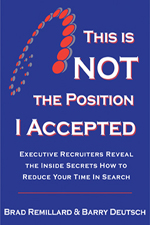
The Job Search Plan Self-Assessment Tool follows the structure of our Career Success Methodology, described in great detail in our recent book titled “This is NOT the Position I Accepted” and expanded upon in our Job Search Home Study Course.

If you follow our Career Success Methodology — which is the ONLY systematic approach to conducting a job search that has been deeply researched, field-tested with live candidates, and validated for success – you’ll significantly reduce the time it takes to complete your job search.

There are lots of experts out there – resume writers, interview coaches, personal branding experts, job board consultants – however, none of them bring an integrated approach and systematic methodology to the process of conducting a job search.

The Career Success Methodology starts with Day One of your Job Search and takes you through every step of the process to the end-point of negotiating your expectations, resources, compensation, benefits, and long-term opportunity.

If you take this Job Search Plan Self-Assessment, even if you don’t invest or agree with our Career Success Methodology, you’ll still be able to identify the key areas in your job search which still require significant work and improvement.

After just a few minutes, the scoring will reveal why your job search is taking too long, why your job search is stalled, or why your job search is NOT generating the level of job leads, referrals, interviews, and offers you wish you could obtain. Most of these problems stem from making the same job search mistakes over and over again.

Join us Monday on LATalkRadio.com at 11 AM PDT to discuss, comment, and share your insights from the Job Search Plan Assessment Tool. We’ll provide the link to the tool in our LINKEDIN Discussion Group by Monday morning at 8 AM PDT so you’ll have an opportunity to score yourself prior to joining us for the radio show.

In the Radio Show, Brad and I will talk about how the Job Search Plan Self-Assessment Tool will help you overcome the most common Top Ten Job Search Mistakes. We’ll walk you through each of the main scoring categories and talk about steps to improve your job search and reduce the time it takes to find a great opportunity.

Barry

P.S. Join our LinkedIn Job Search Discussion Group for one of the fastest growing and vibrant job search discussion groups on the Internet

Weekly Job Search Round-up: August 1st-7th

Round-up of our blog posts on job search

Here is a round-up and review of our blog posts over the past week. Our blog posts have covered the spectrum of job search mistakes, resumes, networking, leveraging social media, and techniques to reduce your job hunt timeframe by at least 50%.


The Top Ten Job Search Mistakes – Are You Guilty?

We explore the most common Top Ten Job Search Mistakes based on research over 25 years. Are you making one or more of these mistakes in your job search?


Un and Under-Employment: What You Don’t Know

Recognize the emotional side of being unemployed in one of the worst job markets we’ve seen in 25 years. We interview of the leading experts on dealing with the emotional side of a job search.


Stay tuned next week as we begin to explore each of the Top Ten Job Search Mistakes and how you can overcome them. Imagine how quickly your job hunt could be over by just avoiding a few of the most common pitfalls to conducting an effective job search.

We will also begin to take an in-depth look at most powerful technique ever used to prepare for any interview question. Using this one preparation technique which is a core element of our Career Success Methdology, you’ll have potential employers almost begging you to come and work for their company.

Barry

Don’t Be “OUTED” In An Interview

A friend CEO recently reminisced about a conversation he had with his executive team. I thought this directly related to so many candidates that I felt compelled to share it with you.

The CEO said to his team, “In order to survive this market without cutting back we must “OUT” our competition. We must, out deliver, out perform, out service, out sell, out market, out price, out satisfy, out prepare and out them with every thing we do. We can’t leave anything to chance. If we don’t, many of our team will be out and ultimately we may be out.”

WOW, pretty powerful stuff. So how does this relate to you – the candidate.

You have to “out” your competition too, or as the CEO said, “You will be out.” In this case, out of the running for the job you not only want, but need.

So how do you “out” your competition? Two words, “Proper Preparation.” This in my opinion is the all time biggest reason candidates fail. The optimum word is “PROPER.” I didn’t say candidates don’t attempt preparation. I believe they do. The problem is that the preparation is so superficial and vague it is worthless. (See blog entry on “Where’s Wes – Not Waldo).

Here are a few tips on how to properly prepare:

  1. Proper preparation is NOT about researching every “trivial pursuit” fact about the company since it started in 1950. Good stuff to know, but when was the last time in an interview you were asked, “Tell me everything you know about the company?” I suggest never. Instead prepare for the questions you will be asked.
  2. Proper preparation is writing out complete and detailed answers to commonly asked questions. In case you missed it, writing out. Just to stress the point, writing out.
  3. Practice, practice, and then more practice. Just like all professional speakers, entertainers, professional sports players, and performers you must practice. They practice so much that it looks easy, unrehearsed, unscripted, succinct, points clearly articulated and engaging. Few candidates are good enough to wing it.
  4. Did I mention writing out the answers to the most commonly asked questions?
  5. List multiple accomplishments for every position. Multiple because an accomplishment for one company may not be an accomplishment in another. Accomplishments MUST include quantifiable results. Forgetting this part would be like forgetting the punch line in a joke.
  6. Video yourself in a mock interview. This will be a real eye opener for many.

If you want to “out” your competition you must be so well prepared and practiced that you stand out. You can’t leave anything to chance.

Final note for all of those now thinking, “I already know all this stuff.” Great, but are you doing it? We all know a lot of things, the problem is doing them. The bigger problem is doing them at such a high level of skill that they look easy.

To help you “out” your competition we provide a wealth of free resources and tools. Our free audio library is full of helpful subjects, the articles are free to download, our Linkedin discussion group expands the wealth of resources to other qualified people, and we constantly post new stuff to help you “out” the competition. Consider bookmarking our candidate FREE Resource page and check back at least weekly.

Our comprehensive job search workbook is FREE to read and implement the preparation tools and templates included. This will ensure you have the right preparation process. With a reader rating 4.25 out of 5 it is certainly worth considering.

If this was helpful please share it with your friends so they also benefit.

We encourage comments and look forward to your thoughts.