Posts tagged: Resume

How Recruiters Read Resumes In 10 Seconds or Less

The 10 or 20 seconds it takes to read a resume seems to always generate a lot of controversy. Candidates comment on how disrespectful it is, how one can’t possibly read a resume in that time and some get angry at recruiters when we talk about this. I hope this article will help everyone understand how we do this. I realize that some still may not like it and will still be angry, but at least you can understand how it works.

First, let me say I’ve been a recruiter for 30 years.  I’m sure I have reviewed over 500,000 resumes. I can’t prove this but I’m reasonably confident that this is the case, as this is only an average of about 46 a day. I know many days I have reviewed hundreds of resumes and most in less than 20 seconds. I would say the average is probably around 5 to 7 seconds.

So for the record when you hear or read about, “reading a resume in 20 seconds,” that isn’t completely true. It is more than likely, “reviewed the resume in 20 seconds.”

Here is my process for getting through 100’s of resumes in a short period of time. Others may have different ways and I welcome your comments.

I set up a hierarchy of certain “must haves” or you’re out, so at first I’m really just box checking. Generally, 80% of the time these are my knock out blows. There are exceptions to each of these, but I’m dealing with the 80/20 rule. These are not cumulative times.  This is box checking, if I see any one of these as I scan your resume you will be excluded.

1. Location. If the client is in Los Angeles, CA and you aren’t – goodbye. Few if any clients want to relocate anyone in this economy, and I believe most shouldn’t have to. Especially in a huge metropolitan area like Los Angeles. If they do have to consider relocation the position has to require some very unique experience that few jobs do. I can do this in about 1 second.

2. Industry. If my client is in banking and your background is primarily manufacturing – goodbye.  These two often are so different that the client isn’t open to considering such different industries. This works both ways, if you have a manufacturing background I’m not going to consider someone with banking. 2-3  seconds to determine this.

3. Function. If I’m doing a sales search and your background isn’t sales – goodbye. Generally companies are paying recruiters to find them a perfect fit. We never do find a perfect fit, but we have to be very close. They don’t need a recruiter to find them someone in a completely different function. 2 seconds to figure this one out.

4. Level. If I’m doing a VP level search and your title is “manager” and you have never been a VP – goodbye. There are exceptions to this, but again it is the 80/20 rule. Again, clients pay me to find them the perfect fit. It is generally way too big of a jump from manager level to VP level, all other things being equal. It works the other way too. If  I’m looking for a manager and you are a VP – goodbye. I know you are qualified to do a manager level role, but it is clear you have grown past. Most clients and recruiters aren’t willing to take the chance that when a VP level position comes along that you won’t be gone. Less than 5 seconds to figure out.

5. Recent Experience. There is some overlap on this one. If I’m searching for someone with international sales experience in the aerospace industry and the last time you held an international sales position in this industry was 20 years ago and since then you have been in retail – goodbye.  I can find people with more relevant experience and that is what my client expects me to do. 5 seconds to do this.

6. Education Like it or not, I will only work with people that have a college education and most of the time a master’s degree. This is mainly because, as I indicated before, I need to find the very best for my clients. I realize an education doesn’t mean by itself that the candidate is the best, but it is one qualifier of many. Also all of my clients require at least a BA.

7. Turnover. If you have had 6 jobs in the last 4 years, or have a track record of high turnover – goodbye. I realize there are good reasons for turnover and that falls into the 20% of the 80/20 rule. I can’t define high turnover, but I know it when I see it. 3 – 5 seconds.

8. Functional resume. I don’t read them. It is obvious when one has a functional resume they are trying to hide something and I’m rarely going to take the time to attempt to figure it out. 1 second.

9. Obvious things such as, spelling errors, poor format, errors in grammar, too long, verbose and rambling. If after reading it I still can’t figure out what you do, goodbye. 5 – 10 seconds

After all this, 80 – 100% have been eliminated. If there are any left, then I will take the time to actually read  them in detail.

Join our LinkedIn Job Search Networking Group for a lot more discussions, information and articles on your job search. CLICK HERE to join.

Download a sample cover letter proven to work with recruiters and get your resume noticed. CLICK HERE to download yours. Over 2,000 people have done this.

If this was helpful to you, please pass it along to help others in  your network. Consider adding it to your status on LinkedIn, posting on Twitter, or emailing the link to your network. Please help others if this helped you.

I welcome your thought and comments.

Brad Remillard


Job Hunting Three “P’s” Will Change Your Results

In my recent article, Job Stalled? Do What the Pro’s Do, I discussed how when things aren’t going well or when results have changed, it may be time to get back to the basics. Take a look at what has changed from the past, reevaluate what was working and what wasn’t. Most processes have certain basics that must be followed. If we get away from these basics things go sideways.

One of those basics is following the three “P’s.” You can’t get much more basic than these. Take an objective look at  your search and see if you are effectively implementing these in your search.

1) Presentation. I harp on this all the time. Candidates so often down play this or take it for granted. For some reason candidates just don’t focus enough energy here.  This is the most basic of basics. Remember the most qualified person doesn’t always get the job, but the person with the best presentation and some minimum level of qualification will often get the job. PRESENTATION, PRESENTATION, PRESENTATION is the place to start.

Start with  your resume. How does it present you and your accomplishments, experiences and skills? One big presentation error we regularly find, and also one of the biggest complaints by other recruiters, HR and hiring managers is  that resumes leave off very important and vital information for the reader. Is yours doing this?

Video your interviewing presentation. If your body language, hand motion, voice inflection and eye contact is weak work on getting help to fix these. Again, very basic but one of the most overlooked problems by most candidates.

2) Preparation. If the presentation is working, now it is time to start preparing. This is a big job and again so often taken for granted by candidates.

Prepare your marketing plan. Are you in the right networking groups? Maybe it is time to change the groups you are attending. Are you meeting the right people? Look back over the people you met with in the last 3 months and evaluate who and what types of people have been helpful and those that didn’t provide any assistance. Identify companies and people you want to meet. Set up a plan to meet them. If you contacted a company 6 – 8 months ago things may have changed, so consider reconnecting or finding another way into the company.

If you haven’t video recorded yourself in a mock interview,  I promise you it is time to do this. Before you do, prepare yourself for what you are about to see. Most don’t like what they see. Have someone else with you when you view the recording. This person needs to be someone who will be objective and honest. Listen to the constructive criticism.

3) Practice. This is probably the most important of the three “P’s.” Everyone has heard, “Practice makes perfect.” Well that also applies in a job search. Practice your body language. DON’T JUST THINK, “I now know that so I won’t do it in an interview.” Of course you will, it is your nature, and with all of the other distractions in the interview you don’t need one more.

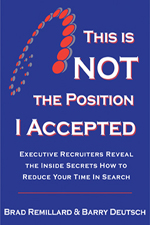
Practice exactly how you are going to answer the standard questions asked in just about every interview. If you don’t know them, our book, This Is NOT The Position I Accepted, has a list of the most commonly asked questions in an interview. You can get the book now to review for just the cost of shipping $5. Might be worth it. (CLICK HERE for details).

These should be so well rehearsed that they come off as if it is the first time you answered the question.

Underestimating these three “P’s” is a fatal job search mistake most candidates make. They either take them for granted or will read this and say, “I already know this,” then go back and do the same things they have always been doing. For this group I highly recommend looking up the definition of insanity.

Join our Linkedin Job Search Networking Group. Over 3300 members and lots of articles, discussion and resources for you. CLICK HERE to join.

For help with your job search take a look at our University. All the support you need is available to jump start your job search. CLICK HERE for details.

Get a free chapter from our job search workbook, This Is NOT The Position I Accepted on the phone interview. CLICK HERE to download.

Resume Tweaking May Be Better Than An Overhaul

I was meeting with a candidate today, we will call him Andy, who recently landed. He had been on the market for about 5 months. He did all the right things, went to the networking meetings, drank more coffee than he should have, reworked his resume over and over, all for nothing. He would get interviews but never make the cut. He had sent out lots of resumes with moderate success.

About 2 month ago I met with Andy and a group of financial professionals, mainly CFOs,  to do a resume review exercise. You might try this exercise.  Everyone brings their current resume and passes them face down to the person next to them. Then at the same time everyone turns the resume over and for 10 seconds reviews them. After 10 seconds all resumes go  face down again. The next step gets to the real purpose for the exercise. The person that read the resume for 10 seconds gives feedback on exactly what they learned about the person’s background, companies, position, location and any other information they took away in that short period of time. Why you ask? That is about how long most people first look at a resume, so the purpose is to find out if the person reading the resume for 10 seconds captures from the resume what the owner of the resume wanted them to. If not, then they need to change the resume.

After the meeting I started working with Andy as part of our Job Search Coaching program. The first thing I noticed was Andy’s resume had him as a CFO. The reality was that compared to other CFOs in the group Andy could not compete. He was really a controller. Andy was trying to play at a level that he wasn’t competitive.  He lost out every time, either when the resume was submitted, or during the interview.

We made a small tweak to his resume by taking off  all references to CFO and changed them to controller. Everything else remained the same. Within two weeks Andy started getting interviews and within 6 weeks he was working. He credits all of the activity and the job to this one tweak of his resume.

Sometimes one small change can make all the difference. Make sure you are playing in the right league. Andy wasn’t, and his resume clearly communicated that. Like most candidates I coach, candidates think only about themselves and not the competition. Andy had clearly done this. He would have been working months earlier had he thought about this.

Join our Linkedin Job Search Networking Group. It has over 3200 members with lots of articles and discussions. CLICK HERE to join.

Download a free sample cover letter that has proven over and over to get candidates noticed and align their experience with what the company is looking for. Join the hundreds that have download this by  CLICKING  HERE.

Check to see if your job search needs tweaking. Download our free Job Search Self Assessment Scorecard. It will highlight what you are doing well and what you need to tweak. CLICK HERE to get your scorecard.

Resume Do’s and Don’ts

Every person that has put together a resume knows the basics, no spelling errors, limit to two pages, chronological format, use keywords and so on, but there are other basic issues that candidates do and don’t do that  have a big impact on getting their resume noticed. By getting noticed I mean read and ultimately you get a phone call or email.

Lets all agree there is only one reason for a resume, and that is to get an interview. That is it — PERIOD. A resume isn’t to get you a job, it isn’t a networking tool, it isn’t a bio and most important of all a resume  isn’t ABOUT YOU.

A resume is about the person reading the resume. If the only purpose is to get you an interview, then the resume better stand out so they take the time to read the resume. Standing out doesn’t mean gimmicks, highlighting or other tricks that only make you look desperate. Standing out means they see what they are looking for and want to read on and ultimately engage  you.

I believe candidates need to realize how people review resumes or take a step back, be very objective, and think about how they reviewed resumes when they had a stack of 100+ resumes sitting on their desk.

I know for me it starts with the 10 second review.  I’m looking for a few box checking items or points and if they are missing, or aren’t a fit, I move on. For example:

  • If my client isn’t going to relocate, and you are from out of the area, you are gone.
  • If I’m searching for a VP of X and you are a VP of Y you are gone.
  • If for whatever reason you have to have experience in a specific industry and you don’t, or haven’t at least worked in an industry that is a close fit, you are gone.
  • If my client is a small entrepreneurial company and you have only worked in very large companies you go into the “B” pile.
  • If you have had 8 jobs in the last 8 years chances are you are either gone or in the “B” pile.
  • If the scope of your positions don’t align with my client’s you are gone. For example,  if I’m searching for an International X and all your resume discusses is domestic, I think you know what is going to happen.

A recruiter, HR person or hiring manager can determine these in 10 seconds or less. Once all of these fundamentals are box checked then I’m going to take the time to read the resume in more detail. It is here that the rubber meets the road. This is where the resume needs to be about my client, NOT YOU. It is here that I’m making the decision of whether to pick up the phone and call you or not.

So it is critical under the “do” column of “Resume Do’s and Don’ts,” that you meet these basic screening issues or at least in one fashion or another address them.  For example, if you are open to relocation and willing to pay your own relocation expenses that should be in the cover letter. This could help level the playing field with local candidates,  if other points on your resume are compelling. You may go to the “A” or  “B” pile instead of being eliminated.

Under the “don’t” column of  “Resume Do’s  and Don’ts,” you need to make sure that when the person gets to the reading stage of your resume that you don’t discuss  irrelevant issues or accomplishments. This is the time to stand out, differentiate yourself and hit a home run.

The biggest “don’t” is don’t try to get by with a one-size-fits-all resume. These resumes are so generic it is impossible to know exactly what the candidate actually did. The bullet points don’t include results and are so vague the reader could change the name at the top and the resume would be like all the rest.

Don’t regurgitate the duties, tasks and responsibilities of the job in bullet point format.  Most companies will not consider you a great hire if all you do are the very basic duties of the job. Your bullet points should demonstrate the exceptional work you have performed. The resume bullet points should sing out loud and clear, “Here are the benefits to you if you hire me.”

Change  your perspective on the resume. Stop thinking of it as a resume about you. Start thinking of it as a marketing document or advertisement. These are generally about the targeted audience and designed to get their attention.

Join our Linkedin Job Search Networking Group along with over 3100 others. Exceptional articles and discussions are all free. CLICK HERE to join.

To help  you build a great resume, we have a put together our “Complete Resume Writing System.” Everything  you need to make sure  your resume is compelling and about the reader is included. Candidates spend hundreds of dollars on resume writing  services when they don’t have to. Our Complete Resume Writing System is available for just $39.95. CLICK HERE to at least see if it can help you. It will save you hundreds.


Resume Do’s and Don’ts – Radio Show

Knowing how your resume is screened will help you understand why you do or don’t hear back from recruiters, HR or hiring managers. These are not the basic do’s and don’ts such as spelling, grammar, or formatting.  You already know those things. We are discussing the practical application of the most common mistakes candidates make that result in their resume getting screened out. Most of these mistakes are so easy to fix, so common sense and so obvious one wouldn’t think it would take a whole show to discuss. We give you insight into what our clients tell us, their actual screening methodology and what you can do to get past the 10 seconds resume screening 90% of the time.

Join our LinkedIn Job Search Networking Group along with 3100 other LinkedIn members. To join CLICK HERE.

You can download for FREE a Job Search Self-Assessment Scorecard. This will help evaluate the strengths and weaknesses in your job search so you can identify what  you need to tweak. This will help you conduct the most effective job search possible. CLICK HERE to get your free assessment.

To download this and past radio shows in our audio library -  CLICK HERE

How NOT to Differentiate Yourself From Everyone Else

As candidates become more and more desperate in their job search they often turn to desperate measures that more often than not hurt the candidate. One example of this is with the resume.

Lately we have been noticing an increase in resumes that contain some sort of gimmick or strange presentation to get noticed. This is not necessary. If your resume is focused, well presented, and easy to read, it will get noticed – at least by us.

If your resume has a lot of highlighting, gimmicks, smells like perfume, or is on bright colored paper, all that is saying to the reader is, “I’m desperate.” Companies today don’t want to hire desperate people. They still want to hire the best and the brightest.

The best ways to get  your resume noticed and read is:

  • Have a good cover letter. Download a free sample from our Web site. CLICK HERE.
  • Have an easy to read resume. Use bullet points instead of long paragraphs, make sure it is not over crowded, has white space, 12 point fonts, two pages,  and does not have a lot of abbreviations, functional or industry jargon.
  • Make sure vital information used for screening stands out such as,company description and industry, title, dates, organization, number of people managed, scope of responsibility, etc.
  • Pleasing to the eye.
  • Well organized and laid out.
  • Highly recommend chronicle not functional.
  • It should be as targeted to the position as possible and that bullet points address what the hiring manager is looking for. NOT a generic one size fits all.

There are probably more and feel free to comment and add  your ideas. Just don’t try and stand out by using desperate gimmicks and tricks.

Join our Linkedin Job Search Networking Group along with the other 3000 members. The group contains extensive articles and discussions on conducting a job search. CLICK HERE to join it FREE.

Please download our free sample cover letter to make sure your background aligns with the job needs and stands out. CLICK HERE to get your copy.

I welcome your thoughts and comments.

Brad Remillard

Don’t Underestimate the Power the Four “A’s” Have On Your Interview

In a previous article, “Leveraging the Power of the First Impression Helps You Win the Interview” we discussed just how critical (not important, critical) the first impression is to the interviewing process. One of the suggestions was to understand the most important points known as the four “A’s.”

These four “A’s” can dramatically impact the interview before the interview even starts. That is powerful.

Each of these must be integrated into your interviewing style and come off as if they come naturally to you.

  • Appearance – This is not just how you dress for the interview, it is much more than that. It includes your body language during the interview, how you sit in the chair, the appearance of your resume and cover letter, the appearance of any materials used during the interview, eye contact, and I hate to say it, but it does include physical appearance.
  • Assertive – This is mostly about how you project yourself during the interview. Please take note, the word was not “aggressive.” There is a big difference between aggressive and assertive. Most interviewers respect an assertive person and dislike aggressive people. Do you come across as confident, do you answer the question with a strong voice, do you engage the interviewer during the interview, do you ask probing questions or just sit there and answer questions, do you mirror the interviewer, does your body language and voice have a strong presence?
  • Affable – Are you friendly, outgoing, easy to communicate with, engaging and even have a sense of humor? Does the interviewer feel comfortable talking with you, are they relaxed and feel at ease, do you have some conversational questions to bring up on the way from the lobby to the interviewing room, do you engage in casual conversation and are you building rapport with the person the second they lay eyes on you?
  • Articulate – How well do you communicate? Do you listen to the question? Are your answers sharp and succinct? Do you have proper language skills, syntax, avoid using the word “like”, proper sentence structure and use of verbs? Do you ramble in the interview to make sure you hit every point in your background or are you able to quickly get to the point? This can be one of the easiest of the “A’s” to master. It takes practice and rehearsing, and you will probably need a coach to help you with this one.

On the surface, as you read these, they seem so obvious. Most are thinking, “I already know this stuff.” This may be true, but I think the purpose of the four “A’s” is to highlight in a very simple way some of the key issues many candidates take for granted. As a result they don’t work on mastering them.

There are a lot of dynamics happening at the same time during the hiring process. The more you can master, the better your chances of getting the green light.

Join our Job Search Networking Linkedin Group. There are over 2700 members and an extensive supply of resources for you to tap into. CLICK HERE to join. Membership is FREE.

We have numerous free downloads on our Web site to help you in your search. Sample cover letters, audio downloads from past radio shows,a transferable skills list, Linkedin Profile Assessment Matrix, and our Job Search Self-Assessment Scorecard. All can be downloaded from our home page. www.impacthiringsolutions.com.

Every Monday at 11 AM PDT listen to our radio show from anywhere in the world on www.latalkradio.com channel 2.

I’m Perfect For The Position, So Why Did I Get Screened Out?

Great question. Probably an obvious answer.

The easy answer is, you probably aren’t perfect for the job, at least from the recruiter’s or hiring manager’s perspective. Now that doesn’t mean you aren’t perfect. It may mean you didn’t communicate effectively as to demonstrate just how perfect you are. So you get screened out.

It has been my experience in close to 30 years as a recruiter that candidates too often ignore the competition that also claim to be perfect for the job. As a recruiter in today’s economy, we can get 500+ responses to an executive level position, all claiming to be, “perfect.” With this volume of resumes, emails, phone calls and referrals, you have to demonstrate you are more perfect than all of the rest.

The real question is, “Have you demonstrated you are more perfect than all the others?” I realize candidates generally have limited information about the position, so demonstrating this can be difficult. It isn’t possible to give every screening detail. Anyone who has hired people knows this. Most hiring managers experience the same thing. When you are looking to hire some one you too get resume overload. So how do you prioritize all these resumes, calls, emails, and referrals? Most have set up some sort of checklist to reduce the number to a manageable figure. Some things on the checklist include, industry, company size, compatibility with products, systems, organization, title, turnover, etc. This is important information that is missing from many resumes. The result is you may get screen out or put in the infamous “B” pile.

The next step might be to further read the resumes that passed the checklist to reduce the number even further. It is at this stage that you must really demonstrate that you are perfect for the position. From a recruiter’s perspective this is the point where I want to see how your accomplishments align with what the client is looking for in the person they hire to deliver the results. This is the, “So why did I get screened out?” point.

Here are some suggestions that might help you to not get screened out if you really are perfect:

  1. Customize your resume as much as possible to directly align with the job. Don’t send the one-size fits all resume.
  2. Your bullet points must include quantifiable results, time frame to accomplish, and be believable.
  3. If you don’t know the exact expectations, some research on the company might give you some tips. If your research highlights issues, try to extrapolate how your functional area will participate in these issues and then how your accomplishments align.
  4. Don’t limit your research to the company’s Web site. Look for press releases, announcements, industry trends, local newspapers, business journals, industry periodicals, and Google the company and its competitors. It will take some work, however, the pay off is not getting screened out.
  5. Use a two column cover letter that compares your experience and accomplishments with what their needs are. (You can download a free sample cover letter on our Web site. (CLICK HERE to get yours)
  6. Keep your resume to two pages. Don’t have so much detail that the important points get lost.
  7. Make sure you have the basic screening information on your resume. Step back and be objective as to exactly how you screen resumes when you were a hiring manager with a stack of 300 resumes on your desk.

There are a lot of reasons you can get screened out, even if you are perfect. I’m convinced doing these few things will at least increase the odds in your favor. I’m sure they will increase the odds if you really are perfect for the position.

Join our Linkedin Job Search Networking Group for many more tips on helping you in your job search. CLICK HERE to join – it is free.

Our job search workbook deals with all of the issues one encounters in a job search. To review the book and have it sent to you for just $5 CLICK HERE. Readers rate this book 4.5 stars out of 5.

Traditional Resumes Are Worthless – Video

This short video highlights why most traditional resumes are never noticed. Is your resume about you? About your skills, experiences, and companies you have worked for? If they are then this is probably why your resume is going in the “B” pile.

To get your resume in the “A” pile it can’t be traditional. Standard resumes that worked as little as two years ago will not even get noticed today.

This video will even give you an example of how to change your resume so it isn’t “traditional” and isn’t about you.

Click this link to watch, “Traditional Resumes Are Worthless.” Your resume doesn’t have to be traditional.

Join our LinkedIN Job Search Networking group. Click here to join.

Thousands have downloaded our FREE sample cover letter. If you have not done so, just click here and you can get yours.

Do You Have A Resume Or A Marketing Document?

Does your resume list all of your experiences, all your skills, and even some accomplishments?

Does it outline all of the things you have done in the past that you think are important and can fit on two pages?

Does it clearly indicate all your past duties, tasks and responsibilities for your positions?

All good stuff, but for the most part, missing a lot of the important stuff.

Most resumes are based on, what in selling is referred to as, “features” or “facts.” Every junior sales rep and marketing person knows that people don’t buy on features, they buy on benefits.

Most resumes are simply a list of features the candidate thinks (key word – thinks) are important. In marketing terms it is a, “fact sheet” not a marketing document. If you want to get noticed you have to have a marketing document not a resume. One that markets benefits.

Marketing 101 teaches marketing is all about getting to the customer’s motivation. It is all about what’s in it for them. Few resumes are a true marketing document. Most are some combination of features and benefits, with heavy weighting on features. Few hiring managers will get excited reading a list of features. These are nice to know, but unfortunately, don’t create any emotional reaction. Benefits, on the other hand, do create an emotional reaction. It is this reaction that creates the desire to buy.

For example, you could have the following feature on your resume, “Substantially reduced turnover in first year.” A good fact but no emotional reaction. Instead you could market the benefit to the hiring manager, “Reduced turnover from over 55% to less than 10% in my first year. This resulted in an estimated savings of $150,000 in just hiring costs. It also dramatically increased the quality of work, completely eliminated errors and reduced overtime by 90% resulting in a cost savings from the previous year of $200,000.”

If I am an owner, CEO, or hiring manager struggling with the high cost of turnover, this is motivating and a benefit.

Selling benefits converts your resume into a marketing document. After all, that is what a resume should be.

Join our Linkedin Job Search Networking Group for a lot more on resumes, interviewing, networking and even how to answer the “Tell Me About Yourself?” question.

For much more on converting your resume into a marketing document, our job search workbook has extensive examples, 5 different sample resumes, multiple sections discussing resume do’s and dont’s, plus a template to make a marketing resume, and examples of great resumes. This is yours to review for just the cost of shipping $5. Take a look inside. CLICK HERE. 4.5 stars of 5 from reader reviews.

We encourage your comments and feedback.

Brad Remillard